Selling Crypto Options for Income: The Risk Nobody Advertises
TL;DR. Selling options — covered calls, cash-secured puts, "the wheel" — converts time decay and the volatility risk premium into a stream of small, frequent gains. That stream is real. So is the payoff shape behind it: many small wins, then one loss that is large, fast, and arrives exactly when everything else you own is also falling. This lesson puts numbers on both sides, explains why the "annualised yield" figure is misleading, and shows what professional sellers do that retail sellers do not.
Prerequisites for this lesson: Options basics, The Greeks (theta, gamma and vega), Implied volatility & skew and Hedging with options — because a covered call is the protective put's mirror image, and the IV crush lesson, which showed the event premium that sellers collect.
Why selling looks so good
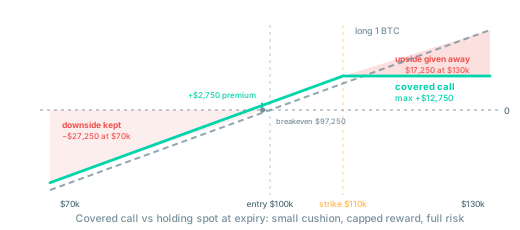
You own 1 BTC at $100,000. You sell a 30-day $110,000 call at 55% implied volatility and collect roughly $2,750 — 2.75% of your position, for one month, for agreeing to sell at a price 10% higher than today. Repeat it twelve times and the brochure says "33% annualised yield".
Or you hold $90,000 in stablecoins and would be happy to buy BTC 10% cheaper. You sell a 30-day $90,000 put at 62% IV (puts carry higher IV than calls in crypto — that is the skew) and collect about $2,870. Either BTC stays above $90,000 and you keep the money, or you get to buy at the price you wanted anyway. "34% annualised."
These numbers are not fabricated. Crypto IV runs two to four times equity IV, so the premiums are genuinely fat. And there are two real reasons the seller has an edge:
- Theta. You are selling a wasting asset. Every calm day, time decay moves money from the buyer to you.
- The volatility risk premium. Implied volatility tends to sit above the volatility that is subsequently realised. Sellers are insurers, and insurers charge more than the expected claim. Most months, the fear priced into options exceeds what actually happens.
So the honest statement is: on average, selling options has positive expectancy. The problem is not the average. The problem is the shape of the distribution around it — and the fact that a retail account is not an insurance company.
The payoff shape you actually own
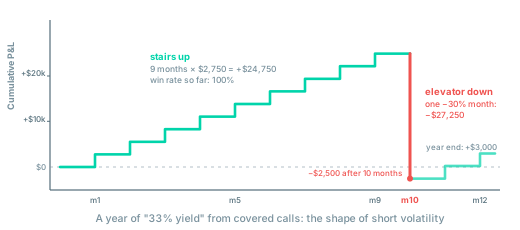
Take the covered call apart. You hold BTC (unlimited upside, full downside) and you have sold a call (you give away the upside above $110,000 in exchange for $2,750). Put together:
| BTC at expiry | Long 1 BTC only | Covered call ($110k, +$2,750) | Cash-secured $90k put (+$2,870) |
|---|---|---|---|
| $130,000 | +$30,000 | +$12,750 (capped) | +$2,870 |
| $110,000 | +$10,000 | +$12,750 | +$2,870 |
| $100,000 | $0 | +$2,750 | +$2,870 |
| $90,000 | −$10,000 | −$7,250 | +$2,870 |
| $70,000 | −$30,000 | −$27,250 | −$17,130 |
Read the covered call row at $130,000 and at $70,000 together. You gave away $17,250 of upside to protect yourself against $2,750 of downside. That is the trade: you keep almost all of the risk of owning BTC and sell almost all of the reward above your strike, for a fee.
There is a deeper identity behind this. By put-call parity — the same relationship that lets a call plus a short perp behave like a put — a covered call is economically a short put at the same strike. Long BTC plus short $110,000 call has the identical payoff to selling a $110,000 put naked. If that sounds more dangerous than "covered call", that is the point: the word "covered" describes your margin situation, not your risk.
The month that pays back the year
Now the scenario every seller must price before the first trade: BTC falls 30% in a month, to $70,000. It has done this more than once — close to 40% in a single day in March 2020, roughly 30% inside a day in May 2021, about a quarter within a week when a major exchange collapsed in November 2022.
| Position (monthly, $100k BTC) | Premium per month | Loss in the −30% month | Months of premium wiped out |
|---|---|---|---|
| Covered call $110k | $2,750 | −$27,250 | ≈ 10 |
| Cash-secured put $90k | $2,870 | −$17,130 | ≈ 6 |
| 10-delta strangle (≈ $124k call + $81k put) | $1,600 | −$9,300 | ≈ 6 |
The strangle deserves attention. A 10-delta option "expires worthless about 90% of the time" — and that statistic is roughly true. What the statistic hides is the size of the tenth outcome. Sheldon Natenberg makes the point bluntly in Option Volatility and Pricing: a trader who sells a 10-delta option and wins nine times out of ten still has a losing strategy if the tenth loss exceeds the nine premiums combined. A 90% win rate with a 1:9 payoff has an expectancy of exactly zero before fees, spreads and the occasional 15-delta-that-became-100-delta.
If you have read the foundations track, you already know this shape: it is the win rate versus risk/reward trap with the ratios pushed to an extreme. A high win rate is not an edge. Expectancy is the edge, and for a naked seller the expectancy is decided by the worst month, not the typical one.
Two things make the seller's bad month worse than a spot holder's bad month:
- It correlates with everything. The crash that costs the put seller $17,000 is the same crash that is hitting their spot bags, their altcoins and their leveraged perp longs. Short volatility is not diversification; it is a second bet on the same calm.
- It is not over at expiry. Which brings us to the part of the story that the "yield" framing skips entirely.
Before expiry: the mark-to-market squeeze
Selling an option is not a bet that settles at expiry with nothing in between. Every second until then, the exchange marks your short at the current price of that option, and that price does not wait for BTC to reach your strike.
Take the $90,000 put again. Five days after you sold it, BTC drops 20% to $80,000 and, as always in a crash, IV explodes — from 62% to 110%. The put is now $10,000 in the money, but it is marked at about $15,500, because the remaining 25 days at 110% IV are worth a lot. Your position shows a loss of roughly $12,650 — 4.4 times the premium you collected — and none of it has "happened" yet in the sense the brochure meant.
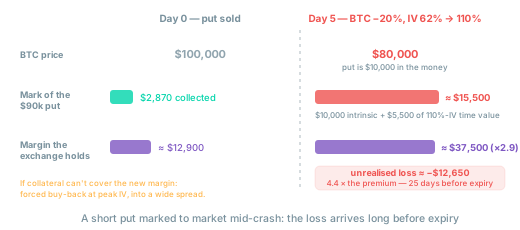
Now the margin. Exchanges margin short options on a formula that scales with the underlying's notional and adds the option's current mark, and the requirement rises as the position moves against you. In the scenario above the requirement roughly triples. If the account cannot post it, the exchange closes the short for you — at the worst possible moment, into a wide spread, at peak IV. The seller's version of a liquidation cascade is not a margin call on a perp; it is being forced to buy back volatility at the top.
There is a crypto-specific twist. On inverse (coin-margined) options, your collateral is BTC. When BTC falls, the put you sold gains value and the collateral backing it loses value. A "cash-secured" put secured with the asset it is written on is secured by something that shrinks exactly when you need it.
The wheel in a trending market
The "wheel" is the retail packaging of everything above: sell puts until you are assigned, then sell calls on the BTC you were assigned until it is called away, repeat. In a range it produces a tidy sequence of premiums. In a trend it produces something else.
Sell the $90,000 put, BTC falls to $70,000, you are assigned: you now own BTC at an effective $87,130 with a $17,130 unrealised loss. The wheel says: sell calls. To collect meaningful premium at $70,000 you sell the $75,000 call. BTC rallies to $95,000. You are called away at $75,000. The unrealised loss has become a realised loss of about $9,600 even after two premiums, and you are flat while the asset is back above your original entry.
The wheel does not create income in a trend. It converts drawdowns into permanent losses by systematically selling the recovery.
What professionals do that retail sellers do not
Market makers and volatility funds are short options most of the time, and most of them are still in business. The difference is not that they have better forecasts. It is four operational habits.
1. They hedge the delta. A professional who sells a put does not want to be long BTC; they want to be short volatility. They sell the put and short an amount of perpetual equal to the put's delta, then adjust as the delta changes. Their P&L becomes "was realised volatility lower than the IV I sold?" rather than "did BTC fall?". This is the mechanism explained in the volatility trading lesson, and it is why professional selling is a full-time job rather than a monthly click.
2. They define the risk. Instead of a naked $90,000 put, they sell the $90,000 put and buy the $80,000 put — a vertical spread. It gives up a third of the premium and caps the worst case at $10,000 minus the net credit. An iron condor does the same on both sides. Defined risk is what makes "sell it and go to bed" survivable.
3. They size by the tail, not the premium. The question is never "how much do I collect?" It is "what do I lose if BTC drops 30% and IV doubles tonight, and can I still trade tomorrow?". Size so that the answer to the second question is yes. The options risk management lesson has the stress-test template; the position sizing guide has the account-level rule.
4. They sell when volatility is expensive, not whenever the calendar says so. Selling after IV has spiked — when the insurance is overpriced — is a fundamentally different trade from selling in a dead-calm market for a tiny premium. Natenberg notes that at-the-money options near expiry in a low-volatility market are among the riskiest positions there are: the gamma is enormous and the premium collected for carrying it is trivial. Retail sellers gravitate to exactly those options because they "expire soon". DVOL relative to its own history is the first thing to look at before writing anything.
When selling is reasonable
None of this means never sell an option. It means selling with the right expectation:
- A covered call at a strike where you genuinely intend to sell. If $110,000 is your profit target anyway, selling the $110,000 call turns "I will sell there" into "I will sell there and get paid $2,750 while I wait". You accept the cap because you already chose it.
- A cash-secured put at a price where you genuinely intend to buy — with cash, not leverage. If you would buy BTC at $90,000 regardless, the put pays you to place the limit order. You accept the assignment because it was the plan.
- Size you already hold or already have in cash. The moment the "yield" tempts you to sell more calls than you have BTC, or more puts than you have stablecoins, you are no longer collecting income. You are a naked short-volatility fund with no hedging desk.
In all three cases the premium is a bonus on a decision you had already made. It is not a return on capital, and the word "income" should be retired from the description.
Pre-trade checklist for any short option
- What is my loss if BTC moves 30% against the strike by expiry? In dollars.
- What is my loss next week if it moves 20% and IV doubles? What margin will the exchange demand then?
- How many months of premium does the answer to question 1 represent?
- Is IV currently high or low relative to its recent history and to realised volatility?
- Is this position defined-risk? If not, why not?
- Would I be content to own (put) or sell (call) BTC at this strike with no premium at all?
If the answer to question 6 is no, the premium is not paying you for a decision — it is bribing you into one.
Where to go from here
You now understand the seller's side of the market: where the edge comes from, and the shape of the risk that pays for it. The next lesson generalises it — selling and buying volatility as a strategy, with the delta hedge that turns a directional bet into a volatility bet:
- Crypto volatility trading — long versus short vol, delta-neutral positions, and the real cost of rehedging.
Related guides:
- Hedging with options — the mirror of this lesson: buying the protection that sellers write.
- IV crush — the event premium sellers collect, and the gap risk they carry through the release.
- Straddle vs strangle — the short straddle and short strangle as pure short-volatility structures.
- Crypto options spreads — turning a naked short into a defined-risk position.
- Crypto options risk management — stress tests, Greeks as risk sensors, and sizing.
- Crypto leverage explained — why "covered" and "cash-secured" stop meaning anything once the position is larger than the collateral.
- Crypto options hub — the full lesson track.
This article is educational content, not investment advice. Trading derivatives, including options, carries substantial risk, including total loss of capital. See disclaimer.