IV Crush in Crypto Options: Right Call, Losing Trade
TL;DR. IV crush is the sudden collapse of implied volatility once a scheduled event is over. Before FOMC, CPI, an ETF ruling or a network upgrade, options carry an uncertainty premium on top of their normal price. The moment the news is out, that premium evaporates — in hours, not days. A trader who buys a call the evening before, watches BTC rise 2% and still closes at a loss has not been unlucky; they paid for a bigger move than the market delivered. This lesson shows how to see the priced-in move before you buy.
Prerequisites for this lesson: Options basics (premium, intrinsic and extrinsic value), The Greeks (vega and theta in particular) and Implied volatility & skew (what IV is and what the term structure looks like). Everything below builds on those three.
What IV crush is — and what it is not
Every option price has two layers. The intrinsic value is what the option would be worth if it expired right now. The extrinsic value is what the market pays for the possibility of movement before expiry. Implied volatility is simply that second layer expressed as an annualised number, so that a $100,000 call and a $30 call can be compared.
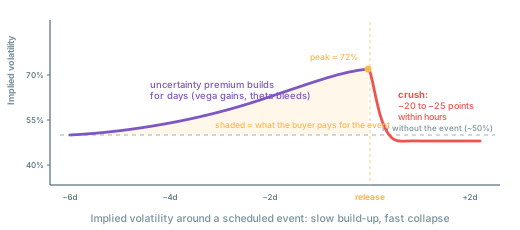
When a scheduled event is approaching, the market knows something with a high chance of moving price is coming, but not which way. Calls and puts get bid at the same time, and IV drifts higher for days. Once the announcement is public, the jump has either happened or it has not — in both cases the uncertainty is gone. Sellers who were charging for it stop charging, buyers who were paying for it stop paying, and IV falls to wherever it would have been without the event. That fall is the crush.
Three things it is not:
- It is not time decay. Theta grinds an option down a little every day. Crush removes a chunk of value in an hour, with the clock barely moving.
- It is not a price move. BTC can be exactly where it was before the number and the option is still worth less.
- It is not a market-maker trick. It is the mathematically correct repricing of an option once a known unknown becomes known. The people who "lose" to it are the ones who bought the uncertainty without noticing its price.
Which events crush in crypto
Crypto trades 24/7, but the events that inflate its options are still mostly on a calendar:
| Event type | Examples | Typical pattern |
|---|---|---|
| US macro data | FOMC decision, CPI, payrolls | IV builds 1–3 days ahead, drops within hours of the release |
| Crypto-native decisions | ETF approvals or rejections, court rulings, exchange listings | Long build-up (weeks), sharp crush, often a "sell the news" spot reversal |
| Protocol milestones | Halvings, major upgrades, hard forks | IV elevated for weeks; the crush is gradual as the date passes uneventfully |
| Large scheduled expiries | Quarterly Deribit expiries at 08:00 UTC | Positioning-driven; IV often falls into the expiry rather than after it |
The contrast is the unscheduled shock — an exchange failure, a hack, a stablecoin losing its peg. Nobody sold the event premium in advance because nobody knew. IV spikes and stays elevated for days. There is no crush to sell, and the option buyer who was already long benefits enormously. Understanding which kind of event you are facing is the first decision, and it is a bigger one than choosing the strike.
Why being right is not enough: a worked example
Let us put numbers on it. BTC is trading at $100,000 the evening before an FOMC decision. A trader expects a dovish surprise and buys a 7-day $100,000 call. Because of the event, the option's IV is 75%.
At entry:
- Premium ≈ $4,140 (about 4.1% of spot)
- Delta ≈ 0.52
- Vega ≈ $55 per volatility point
- Theta ≈ −$300 per day
The decision is announced. It is dovish. BTC rises 2% to $102,000 over the next few hours. The trader was right.
The next morning: IV on that option has fallen from 75% to 50% — a completely ordinary post-FOMC reading. Repricing the call at $102,000, IV 50%, six days left gives a value of about $3,705. The trade is down $437 on a correct directional call.
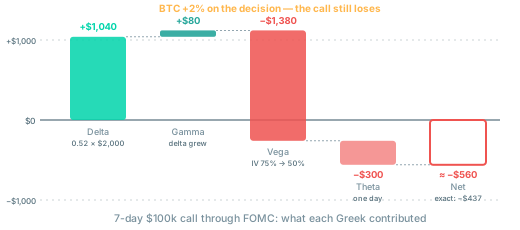
Breaking the result into the Greeks shows where the money went:
| Component | Contribution | Why |
|---|---|---|
| Delta | +$1,040 | 0.52 × $2,000 move |
| Gamma | +$80 | Delta grew as price rose |
| Vega | −$1,380 | 25 points of IV lost × $55 |
| Theta | −$300 | One day of decay |
| Net (Greek estimate) | ≈ −$560 | Exact repricing: −$437; the Greeks themselves shift as IV falls |
Two counterfactuals make the point sharper:
- If IV had stayed at 75% — same 2% move — the call would be worth ≈ $4,955: a $813 profit. The entire difference between winning and losing was the volatility, not the price.
- If BTC had not moved at all, the crush alone would have taken the call to ≈ $2,557: a $1,585 loss in one day, five times the theta.
After the crush, BTC would have needed to be above roughly $102,700 (+2.7%) just for the trade to break even. The market had, in effect, been pricing a larger move than 2%, and the buyer agreed to that price without checking what it was.
How much move is priced in
The question every option buyer should answer before an event is not "which way?" but "how far does the market already expect?". There are two practical ways to read it off the screen.
1. The ATM straddle
The price of the at-the-money straddle — a call plus a put at the same strike — is the market's estimate of the average absolute move to expiry. A useful approximation:
Expected move ≈ 0.8 × IV × √(days ÷ 365) × spot
For our 7-day, 75%-IV example: 0.8 × 0.75 × √(7/365) × $100,000 ≈ $8,300, or about 8.3% — and that is what the straddle actually costs. If your view is "BTC goes up 2–3% on the decision", you are forecasting less movement than the market is charging for. Buying the call is then a bet on direction that must first pay off a volatility bill it cannot afford.
2. Isolating the event with two expiries
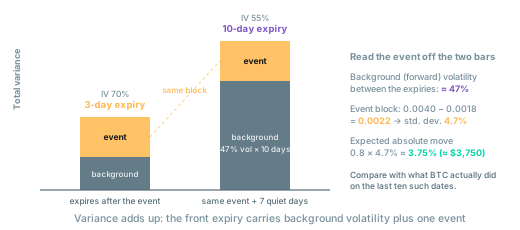
The straddle covers the whole week, event and quiet days alike. Deribit's daily and weekly expiries let you go one step further and price the event alone. The logic: variance (IV squared, scaled by time) adds up across periods. If the expiry just after the event carries more variance than the later expiry implies for the same days, the excess is the event.
Take an expiry three days out at 70% IV and one ten days out at 55% IV, spot $100,000:
| Step | Calculation | Result |
|---|---|---|
| Total variance to day 3 | 0.70² × 3/365 | 0.00403 |
| Total variance to day 10 | 0.55² × 10/365 | 0.00829 |
| "Normal" forward volatility, days 3–10 | √((0.00829 − 0.00403) ÷ (7/365)) | 47% |
| Variance the event adds | 0.00403 − 0.47² × 3/365 | 0.00220 |
| Event standard deviation | √0.00220 | 4.7% |
| Expected absolute event move | 0.8 × 4.7% × $100,000 | ≈ $3,750 (3.75%) |
So the front expiry is "70% IV", but 47% of that is ordinary background volatility. The rest is a one-off jump the market expects to average about 3.75%. Compare that to what BTC has actually done on the last ten FOMC days — that history is public and takes ten minutes to collect. If the typical move is smaller than the priced move, the options are expensive; if it is larger, they are cheap. Most of the time, for most scheduled events, they are expensive. That is the volatility risk premium: sellers of uncertainty demand a margin, and they usually get it.
One honesty note: this trade needs your estimate of a single day's move to be better than the market's, and the result of any one event is noisy. It is a much harder edge than it looks. Euan Sinclair, who lays out this decomposition in Volatility Trading, is explicit that it is a difficult trade even for professionals.
Who is on the other side
Someone sells you the event premium. Mostly it is market makers and systematic volatility sellers who sell the front expiry into the announcement, hedge their delta in the perpetual market, and collect the crush. Their edge is exactly your cost: on average, the premium paid for scheduled uncertainty exceeds the movement that follows. Their risk is the tail — the event that moves 10% when 4% was priced — which is why the next lesson on selling options for income spends most of its length on what happens to sellers on the bad day.
The flow itself matters for scalpers. Dealers who are short options into an event hedge aggressively when price starts to move, which is one of the mechanisms behind the violent first hour after a release. The gamma exposure lesson at the end of this track picks that thread up.
The less obvious traps
Buying the day before is the worst timing. IV rises into events. A trader who buys two weeks early can at least benefit from that rise (positive vega) while theta bleeds; the one who buys at the peak has only the bill. Neither is a free lunch — but the day-before buyer is paying the top tick of uncertainty.
Daily expiries amplify everything. An option that expires the morning after the announcement is nearly all extrinsic value. It combines maximum crush with maximum theta: it either finishes well in the money or it finishes at zero. Note the clock: Deribit options expire at 08:00 UTC, settled on a 30-minute time-weighted average of the index, while FOMC decisions land at 2 pm New York time — 18:00 or 19:00 UTC depending on daylight saving. The "next-day" option holds you through the event and then through another half-day of drift.
An inverted term structure is the warning light. When the nearest expiry's IV sits above the later expiries, you are looking at an event premium. The term structure section of the IV lesson covers what a normal curve looks like; an inversion right before a calendar date is the market telling you, in plain sight, what it is charging.
"Sell the news" hits twice. Crypto-native events in particular often see spot rally into the decision and reverse on it. A call buyer can then lose on IV and on direction within the same hour, after being right about the outcome.
The crush is not symmetric across strikes. After a bullish resolution, put IV often falls more than call IV because the fear that inflated the skew is gone. Which side you are on matters for how much of the crush you eat.
If you still want to trade the event
Being aware of IV crush does not mean never touching options around events. It means choosing structures whose vega exposure matches your actual view.
- Reduce vega with a spread. A vertical spread — buy the $100,000 call, sell the $105,000 call — gives up upside beyond the short strike but cancels most of the volatility exposure, because both legs get crushed together. If your view is a modest move in one direction, this is the structure that expresses it.
- Buy after the crush, not before. If your thesis is a multi-day trend following the decision, options are dramatically cheaper the morning after. You lose the first move; you keep the rest without paying the premium.
- Use the perpetual for the direction. If the whole idea is "BTC up 2% on a dovish Fed", a perpetual future with a defined stop expresses that view with no vega at all. The option's advantage — defined risk — is real, but you must want to pay for it.
- Size it as a lottery ticket. Buying a cheap daily option into an event can be a legitimate small bet on a large surprise. The premium is the maximum loss; size it so a total loss is irrelevant, and accept that the expectancy is negative unless the surprise comes.
Pre-event checklist
- Is this a scheduled event (crush expected) or are you reacting to a shock (no crush)?
- What move does the ATM straddle imply? Is your forecast larger or smaller?
- Is the term structure inverted? By how much?
- How much of your expected profit comes from delta, and how much would a 20–30 point IV drop remove? (Vega × expected drop.)
- Which expiry are you holding through, and when exactly does it settle?
- Would a spread or a perp express the same view more cheaply?
If you cannot answer questions 2 and 4 with numbers, you are not trading the event — the event is trading you.
Where to go from here
You now know how the level of implied volatility behaves around a date. The next lesson looks at how open positions cluster around a price into expiry:
- Bitcoin options max pain — the strike where the most options expire worthless, why price sometimes drifts toward it and why it is not a prediction.
Related guides:
- Straddle vs strangle — the structure that is literally the market's expected move, and the vol-crush trap for event straddles.
- Selling options for income — the other side of the trade: collecting the event premium, and what it costs on the bad day.
- Crypto volatility trading — long versus short volatility as a strategy rather than a one-off event.
- Options risk management — stress-testing a position against an IV shock before you enter it.
- VIX vs DVOL — the index that shows the whole market's IV level moving around an event.
- Crypto options hub — the full lesson track.
This article is educational content, not investment advice. Trading derivatives, including options, carries substantial risk, including total loss of capital. See disclaimer.