Win Rate vs Risk-Reward Ratio: What Makes a Strategy Profitable?
TL;DR. Win rate and risk/reward ratio are not independent — they are two sides of the same equation. A 40% win rate can produce consistent profits with a 1:2 R/R. A 70% win rate can lose money with a 1:0.5 R/R. What actually matters is expectancy: the average amount you gain or lose per trade. Most traders focus on win rate because it feels good. The math doesn't care about feelings.
The fundamental equation
Every trade has two possible outcomes: a win (profit) or a loss (loss). Your expectancy — the expected average profit per trade — is:
Expectancy = (Win Rate × Avg Win) − (Loss Rate × Avg Loss)
           = (Win Rate × R) − ((1 − Win Rate) × 1)
Where R = your risk/reward ratio (how many multiples of your risk you make on a winning trade).
For the system to be profitable, expectancy must be positive: wins must outweigh losses on average.
The minimum win rate for a given R/R
For any risk/reward ratio, there is a minimum win rate needed to break even (before fees). Below this, the strategy loses money over time regardless of how it feels in the short run.
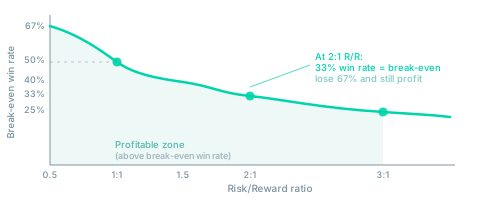
| Risk/Reward | Break-even win rate |
|---|---|
| 1:0.5 (risk 1, make 0.5) | 67% |
| 1:1 (risk 1, make 1) | 50% |
| 1:1.5 (risk 1, make 1.5) | 40% |
| 1:2 (risk 1, make 2) | 33% |
| 1:3 (risk 1, make 3) | 25% |
Example: you risk $100 per trade and target $200 (1:2 R/R). You need to win only 33% of the time to break even. If you win 40% of the time, your expectancy per trade is:
(0.40 × $200) − (0.60 × $100) = $80 − $60 = $20 per trade
A positive $20 expectancy — consistently profitable even though you lose 60% of your trades.
Contrast: you have a 70% win rate but only risk $200 to make $50 (1:0.25 R/R). Your expectancy:
(0.70 × $50) − (0.30 × $200) = $35 − $60 = −$25 per trade
A 70% win rate is losing money. This scenario is common among beginners who cut winners short and hold losers long.
Why beginners naturally gravitate to bad R/R
Human psychology is wired to hate losing. Closing a winning trade feels good; watching a winner turn into a loser is painful. The result: traders take profits too early (reducing average wins) and hold losers hoping they recover (increasing average losses).
This is the primary psychological mechanism that destroys edge. A trader with genuinely good entries can still lose money if they consistently take 1:0.5 R/R on their winners while accepting 1:1 or worse on their losers.
The discipline of maintaining a minimum R/R is not optional. It is the mechanical counterweight to natural psychological bias.
The scalping-specific tradeoff
In scalping, there is genuine tension between win rate and R/R that does not exist as sharply in longer-term trading.
Higher timeframes: a swing trade targeting 5% can easily accommodate a 2% stop (1:2.5 R/R) while winning 45% of the time. The targets are large relative to the noise.
Scalping: targeting 0.3% on a 1-minute chart while noise regularly moves 0.15%, the R/R narrows significantly. Many scalpers find their realistic achievable R/R is closer to 1:1 to 1:1.5 rather than 1:3.
This means scalpers typically need a higher win rate than swing traders to achieve the same expectancy. A scalper with 1:1.2 R/R needs roughly 46% win rate to be profitable. That is not a high bar, but it requires discipline to not let losses run.
The practical consequence: scalpers who chase high R/R (1:3 or more) while trading 1-minute charts often find that targets are too far — price reverses before reaching them. The win rate collapses as most "almost-there" trades close slightly negative.
The solution is not to pick an arbitrary R/R target from a book — it is to measure what R/R ratio your setups actually achieve over a large sample, then set targets accordingly.
Expectancy over samples
Expectancy only means anything over many trades. Over 5 trades, almost any R/R and win rate combination produces a range of outcomes including luck-driven profits and losses.
Over 200 trades, the math asserts itself. This is why:
- Paper trading 30–50 trades is not enough to know if a strategy has positive expectancy.
- A profitable week proves nothing — it might be a lucky streak within a negative-expectancy system.
- A losing week might be fine — a 40% win rate strategy will sometimes have strings of 5–7 losses in a row, which is statistically normal.
The minimum meaningful sample for estimating expectancy is around 100–200 trades. Anything less is anecdotal.
Fees matter more than you think
At every win rate and R/R calculation, fees must be included. If your edge produces $20 expectancy per trade but you pay $8 in fees per round trip, your actual expectancy is $12. Still positive, but the margin of safety is thinner.
If fees are $20 per round trip and your gross expectancy is $20, your net expectancy is zero — you are working for your exchange.
This is why order types matter: a scalper using market orders (taker fees) vs limit orders (maker fees) can have meaningfully different net expectancy from the exact same strategy.
Building your own expectancy measurement
The simplest tracking approach:
- Log every trade: entry, exit, win/loss, profit in R (multiples of risk).
- After 50+ trades: calculate average win in R, average loss in R, win rate.
- Calculate expectancy: (win rate × avg win R) − (loss rate × avg loss R).
- Subtract average fee in R.
- If positive: the system has edge. If negative: diagnose which of win rate, avg win, or avg loss is the problem.
This is not complex mathematics. It is the minimum feedback loop that separates disciplined trading from expensive gambling.
Further reading
- Positive expectancy — the conceptual foundation behind this formula, why edge is invisible on small samples, and why a positive-expectancy strategy can still lose for a while.
- Risk and sizing — how to translate R/R into actual position sizes.
- How to start scalping — why paper trading the expectancy calculation is in the process.
- Order types — how fees affect net expectancy.
This article is educational content, not investment advice. Trading derivatives carries substantial risk, including total loss of capital. See disclaimer.