Options Greeks Explained: Delta, Gamma, Theta & Vega
TL;DR. The Greeks measure how an option's price changes in response to different forces: delta (price moves), gamma (how fast delta changes), theta (time passing), and vega (volatility changing). Volatility — measured as a standard deviation of price returns — is the single most important input in options pricing. You do not need to calculate any of this yourself; every platform shows it. But you need to understand it, because the Greeks determine how your position behaves, how much you can lose, and how options flow creates the forces that move the underlying market.
Start here: why does an option have a price?
Before the Greeks make sense, you need to understand why an option costs what it costs. The answer is rooted in probability and the concept of normal distribution.
The normal distribution — the foundation of all options pricing
Imagine flipping a coin 100 times and recording how many heads you get. Most of the time you will get around 50. Sometimes 45 or 55. Rarely 35 or 65. Almost never 20 or 80. If you plot the frequency of each result, you get a bell-shaped curve — the normal distribution.
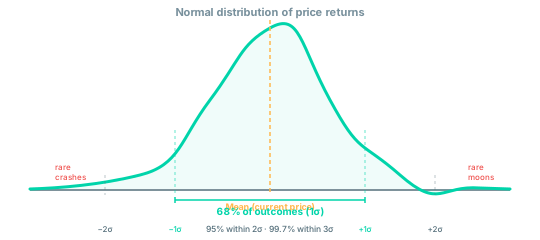
Price returns in financial markets follow a similar (though not identical) pattern:
- Most days, BTC moves a small amount — up or down 1-2%
- Sometimes, it moves 3-5% — noticeable but not shocking
- Rarely, it moves 8-15% — "big day" headlines
- Very rarely, it moves 20%+ — flash crashes, black swans
The bell curve describes the probability of each size of move. The width of this bell curve is what we call volatility.
Volatility = the width of the bell curve
This is the single most important concept in options. Volatility is not "how much price moved today." It is a statistical measure of how wide the distribution of possible future prices is.
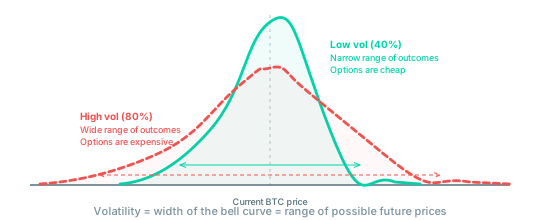
Low volatility = narrow bell curve = most future prices will be close to today's price. Options are cheap because the probability of a large move is low.
High volatility = wide bell curve = future prices could be far from today's price. Options are expensive because the probability of a large move is high.
When you buy an option, you are paying for the area under the curve beyond your strike price. The wider the curve (higher vol), the more area there is beyond any given strike, and the more the option costs.
Two types of volatility
Historical (realised) volatility — what actually happened. Measured by calculating the standard deviation of past daily returns. "BTC's 30-day historical vol is 65%" means that over the last 30 days, the annualised standard deviation of daily returns was 65%.
Implied volatility (IV) — what the market expects to happen. Derived from the current price of options. If BTC options are expensive, IV is high — the market expects large moves. If they are cheap, IV is low.
The relationship between these two is the core of all options trading:
- If you think realised vol will be higher than IV → options are cheap → buy them
- If you think realised vol will be lower than IV → options are expensive → sell them
What "65% annualised volatility" actually means
Volatility is expressed as an annual percentage. To convert to a practical timeframe:
Daily vol ≈ Annual vol ÷ √365 ≈ Annual vol ÷ 19.1
So 65% annual vol ≈ 3.4% per day. This means:
- On ~68% of days, BTC will move less than 3.4% in either direction (1 standard deviation)
- On ~95% of days, BTC will move less than 6.8% (2 standard deviations)
- A 10%+ daily move (3 standard deviations) should happen on only ~0.3% of days — roughly once per year
Weekly vol ≈ Annual vol ÷ √52 ≈ Annual vol ÷ 7.2
So 65% annual vol ≈ 9% per week. This gives you a practical sense: if you buy a 1-week option, the market is pricing in approximately a ±9% potential move.
The Greeks: one by one, on fingers
Now that you understand volatility and the bell curve, each Greek becomes intuitive.
Delta (Δ) — "how much does my option move when BTC moves $1?"
Delta measures the sensitivity of the option's price to a $1 change in the underlying price.
- A call with delta = 0.50 gains $0.50 for every $1 BTC rises
- A put with delta = −0.40 gains $0.40 for every $1 BTC falls
Delta ranges
| Option type | Delta range | Deep OTM | ATM | Deep ITM |
|---|---|---|---|---|
| Call | 0 to +1 | near 0 | ≈ 0.50 | near +1 |
| Put | −1 to 0 | near 0 | ≈ −0.50 | near −1 |
Delta as probability
Delta is approximately equal to the probability that the option will expire in the money:
- Delta 0.25 call ≈ 25% chance of expiring ITM
- Delta 0.50 call ≈ 50% chance (ATM)
- Delta 0.80 call ≈ 80% chance (deep ITM)
This is not mathematically exact, but it is an extremely useful mental shortcut.
The delta S-curve
As BTC price moves from far below the strike to far above it, delta traces an S-shaped curve:
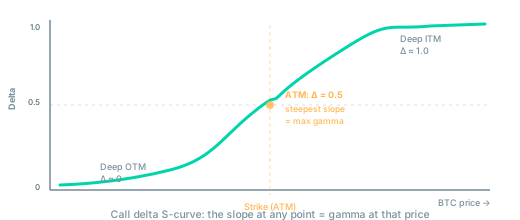
The steepest part of the S-curve is at the ATM point — where delta changes fastest. This rate of change is the next Greek: gamma.
Delta and market flow
Options market makers are delta-neutral — they hedge every option they sell by taking an opposite position in BTC perps. When a market maker sells a 0.50-delta call, they immediately buy 0.50 BTC in the perp market to offset the directional risk.
As BTC price moves, the call's delta changes, and the market maker must adjust the hedge. This is delta hedging — and it creates systematic buying and selling in the perp market that is visible as flow. This is not noise. It is a mechanical consequence of options positions.
Gamma (Γ) — "how fast does delta change?"
Gamma is the rate of change of delta per $1 move in the underlying. It tells you how quickly your directional exposure shifts as price moves.
Why gamma is the key to understanding options behaviour
Think of delta as speed and gamma as acceleration.
A car going 60 km/h (delta) on a straight road has no acceleration (gamma ≈ 0) — its speed stays constant. But a car accelerating from 0 to 100 km/h has high acceleration (high gamma) — its speed changes rapidly.
For options:
- Long options (bought calls or puts) have positive gamma. As price moves in your favour, delta increases — you gain faster. As price moves against you, delta decreases — you lose slower. This is the "convexity" that makes bought options attractive.
- Short options (sold calls or puts) have negative gamma. As price moves against you, delta increases in the adverse direction — losses accelerate. This is why selling options is dangerous without risk management.
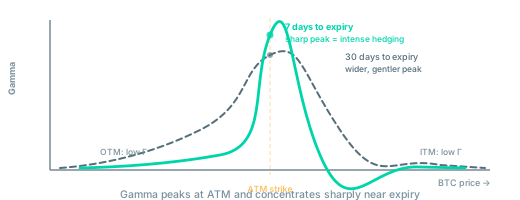
Gamma is highest ATM and near expiry
- ATM options have the highest gamma — their delta can swing rapidly with small price moves
- OTM and ITM options have low gamma — their delta is already near 0 or 1 and does not change much
- Near-expiry ATM options have extreme gamma — delta can swing from 0.2 to 0.8 with a small move
This last point is critical for scalpers. In the days before a major Deribit expiry, if BTC is near a large ATM options strike, market makers face enormous gamma exposure. Every small price move forces aggressive delta-hedge adjustments in the perp market — creating visible, mechanical buying and selling pressure.
GEX (Gamma Exposure)
GEX aggregates the total gamma exposure of all options market makers:
- Positive GEX → market makers buy dips and sell rallies → dampens volatility → range-bound market
- Negative GEX → market makers buy rallies and sell dips → amplifies volatility → trending/explosive market
The final lesson of this track, Gamma exposure (GEX) explained, covers how the number is built, where it concentrates and why its sign is uncertain in crypto.
Theta (Θ) — "how much does my option lose per day?"
Theta measures how much an option's price decreases each day just from time passing, all else being equal.
If your option has theta = −$80/day, you lose $80 every day you hold it, even if BTC does not move at all. This is the rent you pay for holding optionality.
The theta decay curve — why the last week is brutal
Theta does not erode at a constant rate. It follows a specific pattern:
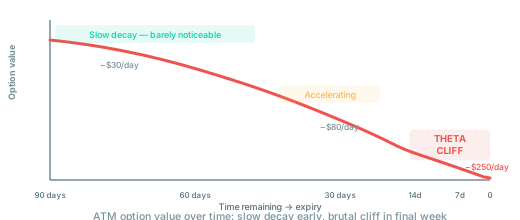
- 90 → 30 days: slow, gentle decay. You barely notice it day-to-day.
- 30 → 7 days: decay accelerates. Each day costs more than the previous.
- 7 → 0 days: the "theta cliff." Extrinsic value melts at an alarming rate. This is why holding short-dated options through a quiet weekend can be devastating.
Theta is the cost of gamma
There is a fundamental relationship: high gamma = high theta. You cannot have one without the other.
An ATM option near expiry has the highest gamma (most responsive to price moves) and the highest theta (fastest decay). This is not a coincidence — it is the mathematical trade-off at the heart of options:
- You want your option to respond to price moves? (gamma) You pay for it with daily decay (theta).
- You want to collect decay from selling options? (positive theta) You accept the risk that price moves against you aggressively (negative gamma).
This trade-off is inescapable. Every options strategy navigates it.
Practical rule
Before buying any option, calculate: theta × days you plan to hold = total time decay cost. If BTC needs to move $5,000 for you to profit, but theta will eat $3,000 over the holding period, the breakeven move is really $8,000. Many traders forget this and are surprised when a correct directional view still loses money.
Vega (ν) — "what happens when the market's mood changes?"
Vega measures how much an option's price changes when implied volatility moves by 1 percentage point.
An option with vega = $300:
- Gains $300 if IV rises by 1 point (e.g., from 60% to 61%)
- Loses $300 if IV falls by 1 point (e.g., from 60% to 59%)
Why vega matters enormously in crypto
Crypto implied volatility is highly dynamic. DVOL (Deribit's BTC IV index) can move from 45% to 75% in a single day during a market panic, or collapse from 70% to 45% after an event passes.
Example: You buy a 30-day BTC call with vega = $250. IV is at 60%.
| Scenario | IV change | Vega P&L | Comment |
|---|---|---|---|
| Market panic | 60% → 80% (+20 pts) | +$5,000 | Your option surges in value from vol expansion alone |
| Post-event calm | 60% → 45% (−15 pts) | −$3,750 | "Vol crush" — option loses value even if BTC moves your way |
| Normal day | 60% → 62% (+2 pts) | +$500 | Small but positive contribution |
The vol crush scenario is the most common trap for retail options buyers. You buy a call before an event, BTC moves in your direction after the event — but IV collapses so hard that the vega loss exceeds the delta gain. Net result: correct direction, negative P&L.
Vega is largest for longer-dated, ATM options
- ATM options have the most vega — they are most sensitive to IV changes
- Longer-dated options have more vega than shorter-dated (more time for vol to matter)
- Deep OTM and ITM options have less vega — they are less affected by vol changes
How the Greeks interact — the complete picture
The Greeks do not work in isolation. They interact constantly. Here is how:
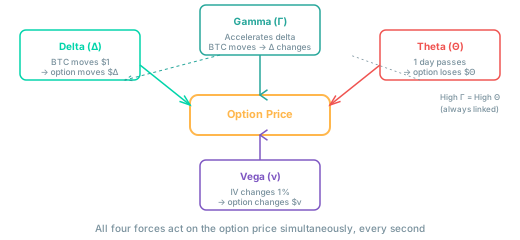
A real example of interaction
You buy a 14-day ATM BTC call at $95,000 for $2,500.
Day 1: BTC jumps from $95,000 to $97,000 (+$2,000).
- Delta ≈ 0.50 → you gain ~$1,000 from the price move
- Gamma is positive → delta has risen to 0.60 (you are now more bullish)
- Theta cost ≈ −$120 for the day
- IV unchanged → vega contribution ≈ $0
- Net P&L ≈ +$880. The price move more than overcame theta.
Days 2-5: BTC stays at $97,000. Nothing happens.
- Delta gain: $0 (no price movement)
- Theta cost: 4 × $130 ≈ −$520 (theta is even higher now because you are closer to expiry)
- IV drops 3 points (event anxiety fading): vega loss ≈ −$450
- Net P&L for these 4 days: −$970. Your correct position is bleeding.
Day 6: BTC jumps to $100,000.
- Delta ≈ 0.70 → gain from $3,000 move ≈ $2,100
- Gamma pushed delta even higher mid-move
- Theta cost ≈ −$140
- Net P&L Day 6: +$1,960.
Total after 6 days: +$880 − $970 + $1,960 = +$1,870. You made money — but the path was volatile, and 4 quiet days nearly wiped out a good entry. This is the reality of options trading.
Reading the Greeks on Deribit
On Deribit's options chain, every contract shows its Greeks in real time:
| Greek | What to check | Quick rule of thumb |
|---|---|---|
| Delta | How directionally exposed am I? | Delta × position size = equivalent BTC exposure |
| Gamma | How fast will exposure change? | High gamma near ATM + near expiry = aggressive hedge flow |
| Theta | Daily cost of holding | Theta × days held = total time cost. Must be < expected gain |
| Vega | Sensitivity to IV changes | Vega × expected IV change = vega P&L. Watch before events |
Why this matters even if you only trade perps
- Options market makers delta-hedge in the perp market. Large options positions create identifiable flow — not noise, but systematic mechanical buying/selling.
- High gamma near expiry concentrates flow. When many options expire near a specific strike, market makers rehedge aggressively, sometimes pinning price near that level.
- IV changes predict regime shifts. Rising IV (rising DVOL) means the market expects larger moves. This correlates with wider perp spreads, more volatile price action, and increased liquidation risk.
- GEX tells you the market's shock absorber status. Positive GEX = dampened volatility (range-bound). Negative GEX = amplified volatility (trending/explosive). Knowing which regime you are in before a scalp trade is a genuine edge.
The Greeks cheat sheet
| Greek | Measures | Buyer (long option) | Seller (short option) | Key insight |
|---|---|---|---|---|
| Delta Δ | Price sensitivity | + for calls, − for puts | Opposite | ≈ probability of expiring ITM |
| Gamma Γ | Rate of delta change | Always + (your friend) | Always − (your enemy) | Highest ATM, near expiry |
| Theta Θ | Time decay per day | Always − (you pay) | Always + (you earn) | High gamma = high theta (linked) |
| Vega ν | IV sensitivity | Always + (you want IV to rise) | Always − (you want IV to fall) | Largest for long-dated ATM |
Further reading
- Options basics — calls, puts, and premiums explained from scratch.
- Implied volatility and skew — how the market prices volatility asymmetrically across strikes.
- DVOL and volatility — the real-time volatility index built from these same options.
- Volatility trading — how to trade the magnitude of movement using delta-neutral strategies.
- Risk assessment — how to use the Greeks as risk sensors before entering a trade.
- Max pain — the expiry-related price level that gamma hedging can push toward.
- IV crush: vega in action: the worked example of a call that loses after a correct directional call.
- Gamma exposure (GEX): gamma at the level of the whole market: dealer hedging flows, walls and the flip level.
This article is educational content, not investment advice. Trading derivatives carries substantial risk, including total loss of capital. See disclaimer.