Crypto Options Explained for Beginners: Calls, Puts & Premium
TL;DR. An option is a contract that gives the buyer the right, but not the obligation, to buy or sell an asset at a fixed price before a fixed date. You pay for that right upfront — the premium. Unlike spot, futures or perpetuals where profit moves in a straight line with price, an option's value responds to three things simultaneously: price, time, and volatility. This article explains every piece of that sentence from scratch — with illustrations — so that by the end you understand not just what options are, but why they exist and when they are the right tool.
Why do options exist?
Before any terminology — the reason options were invented.
The problem with linear instruments
When you trade spot BTC or a perpetual future, your profit and loss form a straight line:
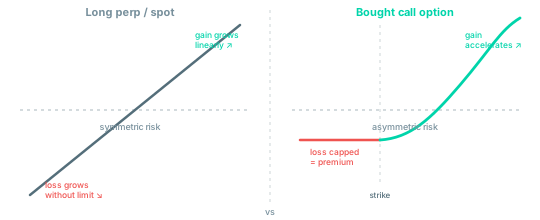
If BTC goes up $1,000, you make $1,000. If it goes down $1,000, you lose $1,000. The relationship is perfectly symmetric and proportional. This is simple — but it has a fundamental limitation: your downside is as large as your upside. In leveraged markets, this means a sharp adverse move can liquidate your position, even if your long-term view was correct.
Options were created to break this symmetry. They allow you to define your maximum loss in advance, while keeping your upside open. You pay for this asymmetry with a premium — like an insurance policy.
The insurance analogy — it is exact, not loose
Consider car insurance. You pay £400/month. If nothing happens, you lose that money — but you do not regret buying it, because you were protected. If you have an accident, the insurance covers the damage, potentially saving you tens of thousands. You never have to file a claim; you just have the option to.
A put option on BTC works identically. You pay a premium. If BTC falls below your strike price before expiry, the put pays out. If BTC stays above your strike, the option expires worthless. Your maximum loss is the premium you paid.
This is not a metaphor. The mathematics of options pricing (Black-Scholes model) was developed using the same principles as actuarial science in insurance. The analogy is exact.
The two types: calls and puts
There are only two types of options. Everything else is built from combinations of these two.
Call option — the right to buy
A call option gives the buyer the right (not the obligation) to buy the underlying asset at a fixed price (the strike) before a fixed date (the expiry).
You buy a call when you expect the price to rise above the strike.
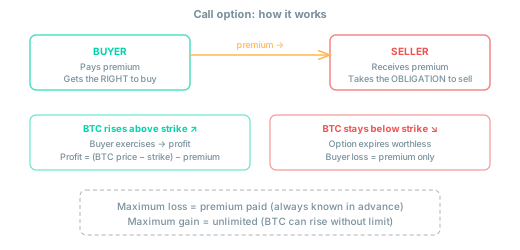
Concrete example. BTC is at $95,000. You buy a call with a $97,000 strike, expiring in 14 days, for $1,200 premium.
| At expiry, BTC is... | Call intrinsic value | Your net P&L | What happened |
|---|---|---|---|
| $100,000 | $3,000 ($100k − $97k) | +$1,800 | Big move up → strong profit |
| $98,500 | $1,500 | +$300 | Moderate move → small profit |
| $97,500 | $500 | −$700 | Right direction, too small a move |
| $95,000 | $0 (worthless) | −$1,200 | No move → max loss = premium |
| $85,000 | $0 (worthless) | −$1,200 | Crashed 10% → still only lost premium |
Notice the last row: BTC crashed $10,000 — but your loss is still just $1,200. With a perp long at $95,000, you would have lost $10,000 (or been liquidated). This is the core advantage of options: your downside is capped.
Put option — the right to sell
A put option gives the buyer the right to sell the underlying asset at the strike price before expiry.
You buy a put when you expect the price to fall below the strike — or when you want to protect an existing long position against a drop.
Example. BTC is at $95,000. You buy a put with a $93,000 strike for $1,100 premium.
| At expiry, BTC is... | Put intrinsic value | Your net P&L |
|---|---|---|
| $85,000 | $8,000 ($93k − $85k) | +$6,900 |
| $91,000 | $2,000 | +$900 |
| $93,500 | $0 (OTM) | −$1,100 |
| $100,000 | $0 (OTM) | −$1,100 |
The put buyer benefits from falling prices but can never lose more than the premium.
Four roles in every options trade
Every option involves a buyer and a seller. Combined with the two option types, this creates four basic positions:
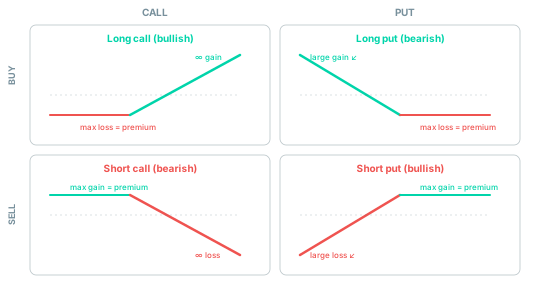
| Position | View | Max loss | Max gain | You pay or receive? |
|---|---|---|---|---|
| Buy call | Bullish | Premium | Unlimited | Pay premium |
| Sell call | Neutral/bearish | Unlimited | Premium | Receive premium |
| Buy put | Bearish | Premium | Strike − 0 | Pay premium |
| Sell put | Neutral/bullish | Strike − 0 | Premium | Receive premium |
Key insight: buying options = limited loss, potentially large gain. Selling options = limited gain, potentially large loss. Most beginners should start as buyers.
What you are actually paying for: the premium
The premium (price) of an option has two components. Understanding them is essential — it is the difference between "I bought a call and lost money even though BTC went up" and understanding why.
Intrinsic value — what the option is worth right now
If you could exercise the option this instant, how much would you get?
- A $97,000 call when BTC is at $99,000 has intrinsic value of $2,000 ($99k − $97k).
- A $97,000 call when BTC is at $95,000 has $0 intrinsic value — it is out of the money.
- A $93,000 put when BTC is at $90,000 has intrinsic value of $3,000 ($93k − $90k).
Extrinsic value — the price of possibility
Everything in the premium above intrinsic value is extrinsic value (also called time value). It represents the possibility that the option could become profitable before expiry.
Premium = Intrinsic value + Extrinsic value
A $97,000 call trading at $1,500 when BTC is at $95,000 has:
- Intrinsic value: $0 (it is out of the money)
- Extrinsic value: $1,500 (entirely the price of possibility)
What drives extrinsic value higher?
- More time remaining — more time = more chance of a favourable move
- Higher volatility — a volatile market has more chance of reaching the strike
- At-the-money strike — the outcome is most uncertain, so the "possibility premium" is highest
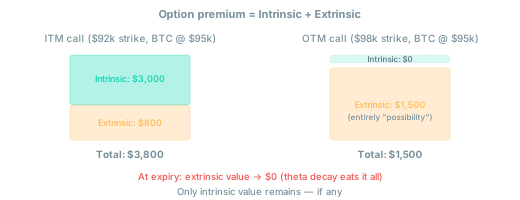
Critical insight: extrinsic value erodes every single day. This erosion — theta decay — is the option buyer's constant cost of holding. By expiry, extrinsic value is always zero; only intrinsic value remains, if any. This is why "BTC went up but my call lost money" can happen: BTC moved in your direction but too slowly, and theta ate through the extrinsic value faster than intrinsic value grew.
Moneyness — where is the option relative to the current price?
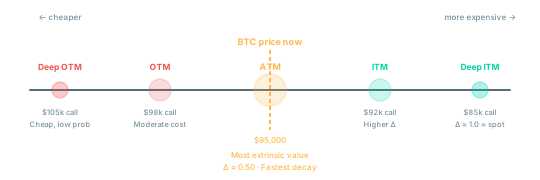
In the money (ITM): the option already has intrinsic value. A $92,000 call with BTC at $95,000 is ITM by $3,000. ITM options are expensive but have a high probability of paying out.
At the money (ATM): the strike equals the current price. ATM options have no intrinsic value but maximum extrinsic value — the outcome is genuinely uncertain, so the market charges the most for the possibility. ATM options have delta ≈ 0.5, meaning roughly a 50% chance of expiring in the money.
Out of the money (OTM): no intrinsic value. A $105,000 call with BTC at $95,000 is deep OTM. These are cheap but have a low probability of paying out. When they do (after a large unexpected move), the percentage return is enormous — which is why they are sometimes called "lottery tickets."
Choosing the right moneyness is one of the first practical decisions:
- Deep OTM: cheap, high leverage, low probability. Best for "black swan" bets or cheap hedges.
- ATM: moderate cost, highest gamma (responds fastest to price moves), highest theta (decays fastest).
- ITM: expensive, high delta (behaves more like the underlying), lower extrinsic value at risk.
Options vs linear trading: the five key advantages
Why would you ever pay a premium instead of just trading a perp or spot? Here are the real advantages:
1. Defined maximum loss
With a long option position, your worst-case loss is the premium — no matter what happens. No liquidation, no margin calls, no stop-loss slippage. BTC can flash-crash 30% in one candle and your loss is still just the premium you paid.
2. Asymmetric payoff (convexity)
As price moves in your favour, each additional $1 of movement earns you more than the previous $1. This is called convexity. With a perp, your P&L is always linear — $1 of movement always equals $1 of profit. With a bought option, your profit curve bends upward, accelerating with each move.
3. Trade volatility, not just direction
With a perp, you must be right about direction. With options, you can profit from movement itself — regardless of which way price goes. Strategies like straddles and strangles allow you to bet on "the market will move a lot" without needing to know if it will move up or down.
4. Time as a tradeable dimension
Options decay over time. This is a cost for buyers, but an income source for sellers. Selling options — intelligently, with risk management — allows you to generate returns from time passing, even when price goes nowhere. This is an entirely new dimension of trading that does not exist in spot or perps.
5. Superior hedging
A put option is the most precise hedge available. You define your maximum loss, you pay a known cost, and your upside remains open. Compare this to hedging with a short perp, which eliminates both downside and upside — a put hedge only eliminates the downside beyond the strike.
The buyer-seller asymmetry
The risk profiles of buyer and seller are mirror images — and fundamentally different:
The buyer pays premium upfront. Maximum loss is fixed and known. Potential gain is theoretically unlimited (for calls) or very large (for puts). The buyer profits only if the move is large enough to overcome the premium. The buyer is long volatility — they want the market to move.
The seller receives premium upfront. Maximum gain is the premium. Potential loss is very large. The seller profits if the option expires worthless — when the market is calm. The seller is short volatility — they want the market to stay quiet.
Most retail traders begin as buyers — limited loss, simple risk profile. Option selling (premium collection) is a valid strategy with higher win rate but much larger individual losses. It requires a clear understanding of the obligations before participating.
European vs American style — what matters in crypto
American-style options can be exercised at any time before expiry. Most stock options work this way.
European-style options can only be exercised at expiry. Crypto options on Deribit (the dominant venue, ~85% of crypto options volume) are European-style.
In practice, this distinction rarely affects you — you can close or sell an option at any time in the secondary market, even if you cannot exercise it early. But it does mean the clean payoff diagrams above apply at the expiry date.
Cash-settled vs physically settled
On Deribit, crypto options are cash-settled: at expiry, you receive (or pay) the difference between the settlement price and the strike in cash — you do not actually buy or sell BTC. This simplifies the process: you never need to worry about delivery.
How to read an options quote
When you see "BTC-27JUN25-95000-C @ $2,400," here is what each part means:
| Part | Meaning |
|---|---|
| BTC | Underlying asset |
| 27JUN25 | Expiry date: 27 June 2025 |
| 95000 | Strike price: $95,000 |
| C | Type: Call (P would be Put) |
| $2,400 | Premium (price you pay) |
On Deribit, premiums are quoted in BTC (e.g., 0.025 BTC), not USD — but the dollar equivalent is always shown. Be aware of this when calculating position sizes.
Practical first steps
If you have never traded options before:
- Start as a buyer. Your maximum loss is always the premium. No surprises.
- Start with ATM or slightly OTM options. They respond meaningfully to price moves without being prohibitively expensive.
- Start with expirations of 7-30 days. Too short (1-3 days) = extreme theta decay. Too long (90+ days) = expensive premium and slow response.
- Track one option through its lifecycle. Watch how the premium changes as BTC price moves, as days pass, and as implied volatility shifts. You will learn more from observing one real option than from reading ten articles.
- Read the next articles before putting real capital at risk.
Where this track leads
This article covered what options are. The rest of the options section explains how they behave:
- The Greeks — how an option's price responds to price changes, time, and volatility. The mechanics that make options work.
- Implied volatility and skew — how the market prices uncertainty, and what the shape of that pricing tells you.
- IV crush: the first practical trap: paying for uncertainty right before it disappears.
- Options vs perpetuals — a deep comparison of the two instruments.
- Options for hedging — how to use puts to protect a long position.
- Volatility trading — how to trade the magnitude of movement, not the direction.
- Straddles and strangles — the specific structures for expressing volatility views.
- Options spreads — verticals, calendars, and butterflies for defined-risk strategies.
- Risk assessment — how to evaluate an options position before entering.
This article is educational content, not investment advice. Options trading carries substantial risk. See disclaimer.