Trading Volatility, Not Direction
TL;DR. Traditional trading requires you to predict where price is going. Volatility trading requires you to predict how much price will move — regardless of direction. Buying volatility profits when markets move sharply in either direction; selling volatility profits when markets stay calm. Both approaches use options combined with delta hedging to isolate the volatility component from the directional component. This is how most institutional options desks operate — and understanding it changes how you think about the relationship between options flow and perp markets.
The fundamental insight
Every investor faces the same problem: predicting where price goes next. Some use fundamental analysis, some use technicals, some flip coins. The success rate, even for professionals, hovers uncomfortably close to 50%.
But there is a second dimension to price that most traders ignore: how much it moves, regardless of direction.
Consider a stock that starts the year at $1,000. Over 52 weeks it fluctuates — sometimes up, sometimes down — ending the year at $1,300. A traditional long investor makes $300. But between those two points, the stock moved up and down hundreds of times. Each of those movements contained extractable value — if you had the right structure.
Now consider a different scenario: the same stock starts at $1,000 and ends at $1,000 — zero return for the traditional investor. But the stock was volatile throughout the year. A volatility trader using the right strategy could have extracted profit from every single fluctuation.
This is the core insight: you can trade the wiggle, not the trend.
What "buying volatility" means in practice
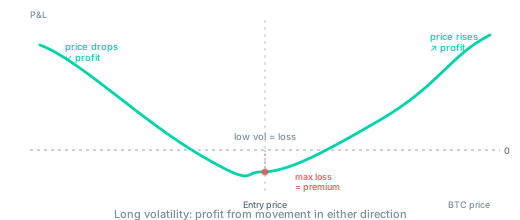
Buying volatility means constructing a position that profits when price moves sharply in either direction and loses when price stays flat. The simplest implementation:
- Buy an at-the-money call option on BTC
- Sell (short) enough BTC in the perp market to make the position delta-neutral
The call gives you convex exposure — it gains value faster as BTC moves up and loses value slower as BTC moves down. The short BTC position offsets the directional component. What remains is pure exposure to the magnitude of movement.
The rehedging mechanism
Here is where it gets practical. As BTC price moves, the delta of your call option changes. The position drifts away from delta-neutral. To maintain neutrality, you rehedge — adjusting the short BTC position:
- BTC rises → the call's delta increases → you sell more BTC to rebalance
- BTC falls → the call's delta decreases → you buy back some BTC to rebalance
Notice what happens: you are systematically selling high and buying low. Every rehedge locks in a small profit from the price fluctuation. Over time, these small profits accumulate — as long as the actual volatility of the market exceeds what you paid for in the option's premium.
This is the elegant mechanism at the heart of volatility trading: the option's convexity (its curved payoff) creates a natural structure where rehedging generates cash from movement.
When it works and when it doesn't
Long volatility profits when: actual (realised) volatility exceeds the implied volatility priced into the option at the time of purchase. You bought the option expecting 60% annualised vol but the market actually delivered 75% — the rehedging gains exceed the theta decay.
Long volatility loses when: the market is calmer than expected. You paid for 60% vol but the market only delivered 40%. The option's time decay (theta) erodes value faster than rehedging generates it. If BTC barely moves, the call slowly loses its extrinsic value and the rehedging gains are too small to compensate.
What "selling volatility" means
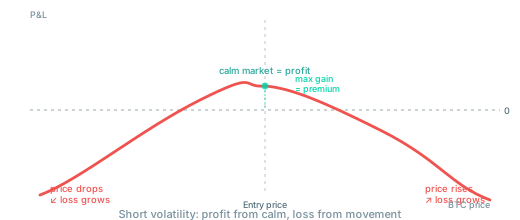
Selling volatility is the mirror image. You construct a position that profits when price stays calm and loses when it moves sharply:
- Sell an at-the-money call option on BTC (collect the premium)
- Buy enough BTC to make the position delta-neutral
Now you are the one collecting theta — the option's time decay flows to you every day. But you face the rehedging problem in reverse:
- BTC rises → you must buy more BTC at higher prices
- BTC falls → you must sell BTC at lower prices
You are systematically buying high and selling low. Every rehedge costs you money. The strategy profits only if these rehedging costs are smaller than the premium you collected — which happens when realised volatility is lower than the implied volatility of the option you sold.
The volatility trade-off: a clear framework
The decision to buy or sell volatility reduces to a single question:
Will realised volatility be higher or lower than the implied volatility priced into the option?
| Realised vol > Implied vol | Realised vol < Implied vol | |
|---|---|---|
| Long vol (buy options) | Profit — rehedging gains exceed theta | Loss — theta exceeds rehedging gains |
| Short vol (sell options) | Loss — rehedging costs exceed premium | Profit — premium exceeds rehedging costs |
This is fundamentally different from directional trading. You are not asking "will BTC go up or down?" You are asking "will BTC move more or less than the market currently expects?"
Why this matters for scalpers
Even if you never trade a single option, understanding volatility trading explains behaviour you see every day in the perp market:
Delta hedging creates perp flow. When options market makers sell calls to retail buyers, they immediately buy BTC in the perp market to hedge. As price moves, they continuously rehedge — buying dips and selling rallies (if they are net long gamma) or buying rallies and selling dips (if net short gamma). This systematic flow is not random noise — it is the mechanical consequence of options positions being delta-hedged.
Volatility expectations move premiums. Before a major event (FOMC, ETF decision, halving), implied volatility rises because the market expects larger moves. After the event, IV often collapses — the so-called "vol crush." Understanding this cycle helps you anticipate when options-driven hedging flow will intensify or fade.
The gamma effect near expiry. As large options positions approach expiry, gamma increases dramatically for at-the-money strikes. Market makers rehedge more aggressively, creating more flow in the perp market. This is why crypto often sees unusual price behaviour around major options expiry dates on Deribit.
Practical considerations
Time decay is the cost of long volatility
Every day you hold a long volatility position, the option loses value to theta decay. This is your "rent" — the cost of maintaining the position. If the market does not move enough to generate rehedging profits that exceed this daily cost, you lose money. This is why long volatility positions require active monitoring and a genuine edge in forecasting volatility.
Transaction costs compress the edge
Each rehedge incurs transaction costs (spreads, fees). In crypto markets, where perp spreads are generally tight, this is manageable — but it is never zero. A volatility strategy that generates 15 small rehedging profits per day, each worth $12, sounds attractive until you account for the bid-ask spread and exchange fees on each of those trades.
You can use puts instead of calls
Everything described above works identically with put options. A long put + long underlying = same exposure as long call + short underlying, once delta-hedged. This follows from put-call parity — the fundamental relationship linking puts, calls, and the underlying. Choose whichever is cheaper or more liquid.
The honest risk profile
Long volatility: frequent small losses (theta decay on calm days), occasional large gains (from sharp moves). Maximum loss is the premium paid. You can survive a string of quiet days, but not indefinitely.
Short volatility: frequent small gains (premium collection), occasional large losses (from sharp moves). The gains are capped at the premium received; the losses are theoretically unlimited. This is why selling volatility without proper risk management is one of the fastest ways to blow up an account.
Where to go from here
- Straddles and strangles — the specific option structures most commonly used to express volatility views.
- The Greeks — how delta, gamma, theta, and vega interact to determine the behaviour of volatility positions.
- Implied volatility and skew — how to read the volatility that the market is currently pricing, and what the skew tells you about directional sentiment.