Options Risk Assessment
TL;DR. Every options position carries multiple simultaneous risks: directional (delta), speed of directional change (gamma), time decay (theta), and volatility change (vega). Evaluating an options trade means understanding not just what happens if you are right, but what happens if you are wrong — on every axis, at the same time. The goal is not to eliminate risk but to know precisely what risks you are taking, how large they are, and whether the expected reward justifies them.
Risk in options is multidimensional
When you buy BTC in the spot or perp market, you face one primary risk: price going against you. Options add several more dimensions:
- Price moves the wrong way (delta risk)
- Price moves the right way but too slowly (theta risk — time decay erodes your position)
- Implied volatility drops (vega risk — your option's premium shrinks even if price is unchanged)
- Price moves the right way but overshoots (gamma risk for spreads — you cap out early)
- All of the above happen simultaneously
Understanding these risks individually is necessary (covered in The Greeks). Understanding how they interact simultaneously is what separates functional options traders from those who are consistently surprised by their P&L.
Using the Greeks as risk sensors
The Greeks are not abstract academic metrics. They are real-time risk measurements that tell you how much money you will make or lose under specific conditions.
Delta: how much do you lose if price moves $1?
A position with +500 delta acts like being long 500 units of the underlying. If BTC drops $100, you lose approximately $50,000. This is your directional exposure — the most intuitive risk to grasp.
Practical check: before entering any options position, calculate the net delta. Compare it with the largest adverse price move you consider plausible in your time horizon. Can you survive it?
Gamma: how fast does your risk change?
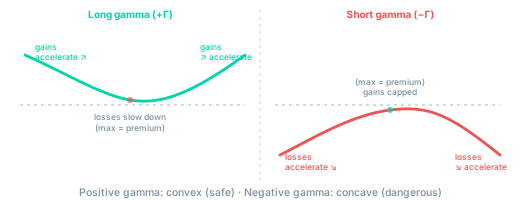
Gamma tells you how much delta will change per $1 move. High gamma means your directional exposure shifts rapidly as price moves. This matters because:
- Positive gamma (long options): your position self-hedges. As price moves against you, your delta decreases — losses decelerate. As price moves in your favour, delta increases — gains accelerate.
- Negative gamma (short options): the opposite. Losses accelerate, gains decelerate. This is the core danger of selling options.
Practical check: if you are short gamma, calculate how much delta your position will have after a 5% adverse move. That is your real exposure in a stress scenario, not the current delta.
Theta: what does it cost you per day to hold this position?
Theta is the daily cost (or income) of the position. For option buyers, it is negative — you lose money every day, all else being equal. For option sellers, it is positive.
Practical check: multiply theta by the number of days you plan to hold. That is your total time decay cost. Is the expected profit from the trade large enough to overcome this cost with a reasonable margin?
Vega: what happens if implied volatility moves?
Vega measures sensitivity to IV changes. If you are long vega and IV drops 5 percentage points, multiply your position vega by 5 to calculate the loss.
Practical check: before events that might cause IV contraction (earnings-equivalent in crypto: FOMC, halving, ETF decisions), calculate the vega loss from a 10-point IV drop. Can your position survive a vol crush?
Stress-testing a position
Professional traders do not just check the Greeks at current market conditions. They stress-test: what happens to the position under extreme scenarios?
The three-axis stress test
For any options position, evaluate P&L under:
- Price shock: BTC moves ±10% and ±20% from current level
- Time acceleration: fast-forward 7 days and 14 days, keeping price unchanged
- Vol shock: IV drops 15 points; IV rises 15 points
Combine these: what happens if BTC drops 10% AND IV rises 15 points? (Crash scenario — price drops, vol spikes.) What happens if BTC rises 5% AND IV drops 10 points? (Rally with vol crush — common after positive events.)
The worst-case combination often reveals risks that are invisible when looking at each Greek in isolation.
A concrete example
You buy a 14-day BTC straddle at $95,000 for $3,200 total premium.
| Scenario | P&L estimate |
|---|---|
| BTC at $95,000, 7 days later, IV unchanged | −$1,400 (theta ate half the premium) |
| BTC at $100,000, 7 days later, IV unchanged | +$1,600 (call value up, put near-worthless) |
| BTC at $100,000, 7 days later, IV down 10pts | +$400 (vol crush offsets most of the move) |
| BTC at $88,000, 3 days later, IV up 15pts | +$4,500 (crash + vol spike = best case for long vol) |
| BTC at $95,000, 14 days later (expiry) | −$3,200 (complete loss — no movement) |
Notice how the same underlying move ($100,000) produces vastly different outcomes depending on time elapsed and IV change. This is why options risk cannot be reduced to a single number.
What makes a good spread?
From a risk assessment perspective, a good options trade has:
-
Positive expected value. The probability-weighted average of all outcomes is positive. This requires an edge — usually a belief that implied volatility misprices the actual expected movement.
-
Survivable worst case. The maximum loss, if everything goes wrong, does not threaten your account. The standard guideline: risk no more than 2-5% of account equity on any single options position.
-
Favourable payoff structure. The ratio of maximum profit to maximum loss is attractive given your estimated probabilities. A 3:1 payoff ratio with a 40% probability of success is a good trade; a 1:1 ratio with the same probability is not.
-
Manageable Greeks. The position's Greek exposures are within your tolerance. If you cannot monitor positions continuously, avoid high-gamma short positions that can swing against you quickly.
When and how to adjust
Not every adverse move requires action. The key questions:
Has your thesis changed? If you entered a bull call spread because you expected BTC to rally above $98,000 this week, and new information makes that unlikely, close the position. The original reason is gone.
Is the position within your pre-defined risk budget? If you allocated $2,000 maximum loss to this trade and you are currently down $1,200, you have $800 of remaining runway. Adjust only if the remaining expected value is negative.
Are the Greeks still acceptable? If your short strangle has developed a delta of −800 because BTC rallied sharply, you may need to adjust — not because you are losing money (you might not be yet), but because the directional risk has grown beyond your comfort level.
Common adjustments
- Roll the position. Close the current options and open new ones at different strikes or expirations. This resets the Greek profile while maintaining the overall strategy.
- Add a hedge. Buy a protective option against the risk that has grown. E.g. if your short put is under pressure, buy a further OTM put to cap the downside.
- Reduce size. Close part of the position to bring the risk back to acceptable levels.
- Do nothing. If the position is within its risk budget and the thesis has not changed, the discipline of inaction is often the correct choice.
Liquidity: the hidden risk
In crypto options, liquidity is concentrated on Deribit, with growing presence on Bybit and Binance. Liquidity considerations specific to crypto:
- ATM options on BTC and ETH have tight spreads on Deribit. OTM options on altcoins can have spreads of 10-30% of the option's value.
- Exiting a losing position costs money. The bid-ask spread works against you on both entry and exit. Factor this into your risk assessment.
- Near expiry, OTM options become illiquid. If you need to exit a far OTM option in the last hours before expiry, you may not find a counterparty — or only at a punitive price.
- Large positions move the market. Deribit's options order book for BTC is deep for retail sizes but thin for institutional sizes. If you need to exit a position worth more than $50,000 notional, you will move the market against yourself.
Rule of thumb: if a position would take more than 3 resting orders to exit in normal conditions, it is too large for your account given the available liquidity.
The honest assessment
Options trading has a reputation for sophistication. But the fundamental risk discipline is simple:
- Know your maximum loss before entering.
- Make sure you can afford it.
- Understand which scenarios cause the maximum loss.
- Have a plan for what you will do if those scenarios begin to unfold.
- Follow the plan.
Everything else — the Greeks, the models, the term structure — is in service of these five points. If you can answer all five clearly before entering a position, you are ahead of most participants.
Where to go from here
- The Greeks — the detailed mechanics of how delta, gamma, theta, and vega work individually.
- Options spreads — how to construct positions with defined risk profiles using vertical, calendar, and butterfly spreads.
- Volatility trading — how to isolate volatility from direction, and the risk profile of long vs short volatility.
- Hedging with options — using puts to protect existing positions, with honest cost-benefit analysis.