Options Spreads: Verticals, Calendars, and Butterflies
TL;DR. A spread combines two or more options to create a position with a defined risk profile. Vertical spreads express a directional view with capped risk and capped reward. Calendar spreads exploit differences in time decay across expirations. Butterflies bet on price staying near a specific level. All three reduce capital requirements compared to outright option purchases, but they also cap your maximum gain. Understanding spreads is essential because they form the basis of most institutional options positioning — and that positioning creates the hedging flow that moves the underlying market.
Why spreads exist
Buying a single option is simple but has drawbacks:
- Calls and puts are expensive. A 14-day ATM BTC call might cost $2,500. If you are moderately bullish, paying full premium for unlimited upside is inefficient when you expect a $3,000–5,000 move at best.
- Theta decay is relentless. A long option position loses value every day. Spreads can partially offset this by selling an option alongside the one you buy.
- Implied volatility risk is one-sided. A long option loses value if IV drops. A spread with a long and short leg has partially offsetting vega, reducing IV sensitivity.
A spread is the solution: buy one option, sell another. The sold option subsidises the purchased option. In exchange, you cap your upside. The result is a position with defined maximum loss, defined maximum gain, and lower cost than an outright option.
Vertical spreads: directional with defined risk
A vertical spread uses two options of the same type (both calls or both puts) with the same expiration but different strikes.
Bull call spread (debit spread)
You are moderately bullish on BTC. You buy a lower-strike call and sell a higher-strike call:
- Buy 1 BTC $94,000 call @ $2,800
- Sell 1 BTC $98,000 call @ $1,100
- Net debit: $1,700
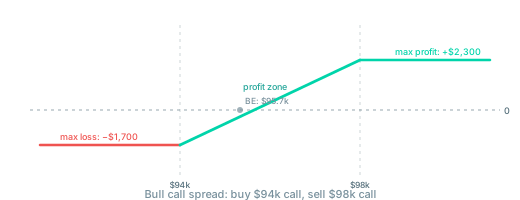
Below $94,000: both options expire worthless. Loss = $1,700 (premium paid). This is the maximum loss.
Between $94,000 and $98,000: the long call has value; the short call does not. Profit increases linearly. Breakeven at $95,700 ($94,000 + $1,700 net debit).
Above $98,000: both calls are in the money. The spread reaches maximum value = $4,000 (distance between strikes). Net profit = $4,000 − $1,700 = $2,300. The short call caps your gain — BTC could go to $150,000 and your profit stays at $2,300.
Risk/reward: you risk $1,700 to make $2,300. The ratio of 1:1.35 is modest, but the probability of reaching max profit is higher than the probability of a naked call paying out the same amount, because the breakeven is lower.
Bear put spread (debit spread)
The bearish equivalent: buy a higher-strike put, sell a lower-strike put.
- Buy 1 BTC $96,000 put @ $2,400
- Sell 1 BTC $92,000 put @ $900
- Net debit: $1,500
Maximum loss: $1,500 (if BTC stays above $96,000). Maximum profit: $2,500 (if BTC falls below $92,000). Same concept, opposite direction.
Why traders use verticals
- Defined risk. You know your maximum loss before entering. No margin calls, no liquidation cascades.
- Lower cost. The sold option subsidises the purchase. You trade upside cap for lower entry cost.
- Reduced theta decay. The short option decays too, partially offsetting the decay on your long option.
- Reduced vega sensitivity. Changes in IV affect both legs, roughly cancelling out for narrow spreads.
The width-reward trade-off
Wider spreads (larger distance between strikes) have higher maximum profit but cost more. Narrow spreads are cheaper but cap your gain sooner. The choice depends on your conviction about the size of the expected move.
Calendar spreads: trading time decay
A calendar spread (also called a time spread or horizontal spread) uses options with the same strike but different expirations:
- Sell 1 BTC $95,000 call expiring in 7 days
- Buy 1 BTC $95,000 call expiring in 30 days
- Net debit: the far-dated option costs more than the near-dated one
How it profits
The key mechanism is differential theta decay. Near-expiry options decay faster than far-dated options (the theta curve accelerates near expiry). By selling the fast-decaying option and buying the slow-decaying option, you profit from the difference in decay rates — as long as price stays near the strike.
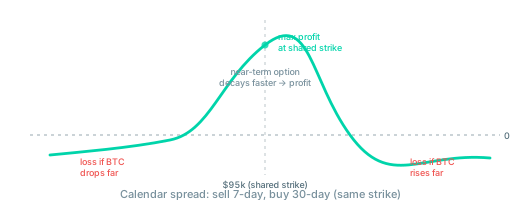
At the near expiry, if BTC ≈ $95,000: the short call expires worthless (or near-worthless). You keep the premium from selling it. The long call still has 23 days of life remaining and retains significant value. The difference is your profit.
If BTC moves far from $95,000: both options lose extrinsic value as they move deep ITM or OTM. The spread collapses. Large moves in either direction hurt the position.
Calendar spreads and implied volatility
Calendar spreads are also a bet on IV changes between expirations. If you expect near-term IV to fall (after an event passes) while longer-term IV holds steady, a calendar spread benefits from the differential. Conversely, if near-term IV spikes unexpectedly, the short leg loses more than the long leg gains.
This makes calendar spreads popular around events with known dates — the short leg targets the event-specific IV, the long leg targets the steady-state IV that follows.
The butterfly: pinpointing a price level
A butterfly spread combines a bull spread and a bear spread, sharing the middle strike. It is a bet that price will expire near a specific level.
Long call butterfly
- Buy 1 BTC $92,000 call
- Sell 2 BTC $95,000 calls
- Buy 1 BTC $98,000 call
- Same expiry for all
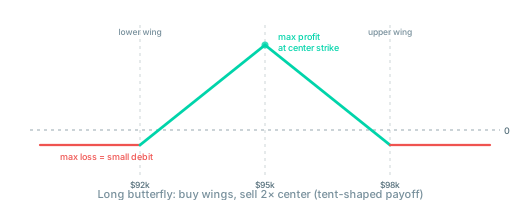
At $95,000: maximum profit. The $92,000 call is worth $3,000, the two short $95,000 calls are worthless, the $98,000 call is worthless. Net value = $3,000 minus the small debit paid.
Below $92,000 or above $98,000: all gains and losses offset. You lose only the initial debit (typically small — butterflies are cheap).
Between the strikes: profit forms a tent shape, peaking at the center.
Why butterflies matter for crypto
Butterflies are inexpensive because you are buying and selling roughly equal amounts of premium. They are often used:
- Around max pain. If you believe the max pain level will act as a magnet near expiry, a butterfly centered on that strike is a cheap way to express the view.
- As hedges. Market makers use butterflies to manage gamma risk around specific price levels.
- To profit from vol crush. After an event, if you expect price to settle near a level and IV to collapse, a butterfly benefits from both.
Choosing the right spread
| Scenario | Spread type | Why |
|---|---|---|
| Moderately bullish, want defined risk | Bull call spread | Capped cost, capped risk, linear payoff in target zone |
| Moderately bearish, want defined risk | Bear put spread | Same structure, opposite direction |
| Expect price to stay near a level | Calendar spread or butterfly | Both profit from price stability near the strike |
| Expect event to be overhyped (vol crush) | Calendar spread | Short near-term vol, long far-term vol |
| Pinpointing a specific expiry level | Butterfly | Cheap, defined risk, high reward if you nail the level |
| Want volatility exposure | Straddle/strangle | Not a spread in the directional sense — pure vol bet |
The Greeks of spreads
Because spreads combine long and short legs, their Greeks are partially offsetting:
- Delta: vertical spreads have moderate delta (they are directional). Calendar spreads and butterflies are approximately delta-neutral near the center strike.
- Gamma: vertical spreads have moderate gamma. Butterflies have negative gamma at the center strike (they lose if price moves). Calendar spreads have positive or negative gamma depending on the expiry date.
- Theta: vertical spreads have mild positive or negative theta depending on moneyness. Calendar spreads typically have positive theta (the main attraction). Butterflies have positive theta near the center.
- Vega: vertical spreads have low vega (the legs offset). Calendar spreads have positive vega for the far leg (they benefit from IV rising on the far date). Butterflies have negative vega near the center (they benefit from IV falling).
How spreads create market flow
Spreads are the most common structure for institutional options trading. When a market maker fills a customer's bull call spread order, they acquire one call and sell another. The net delta of their new position must be hedged in the perp market. As price moves, the hedge adjustments create flow.
More importantly, the concentrated hedging around the spread's strikes creates zones of support and resistance that are purely mechanical — not based on chart patterns or sentiment, but on the options positions that market makers must delta-hedge. This is one reason price often seems to "stick" near large options strikes, especially near expiry.
Where to go from here
- Straddles and strangles — the structures used for pure volatility bets, closely related to spreads.
- Options for hedging — how puts and calls protect existing positions, and why spreads can be more efficient hedges.
- The Greeks — the mechanics behind how gamma, theta, and vega interact within spread positions.