Straddles and Strangles
TL;DR. A straddle is buying (or selling) both a call and a put at the same strike price and expiry. A strangle is the same concept but with different strikes — an OTM call and an OTM put. Both are pure volatility instruments: they profit from movement (long) or stillness (short), with minimal directional bias. These are the bread-and-butter structures for expressing a volatility view in crypto options.
The straddle: the purest volatility bet
A long straddle combines:
- Buy 1 ATM call (e.g. BTC $95,000 call, 14 days to expiry)
- Buy 1 ATM put (same strike, same expiry)
At expiry, one of these options will have intrinsic value (unless BTC lands exactly at $95,000). The question is whether that intrinsic value exceeds the total premium paid for both options.
Payoff at expiry
The payoff profile forms a V-shape:
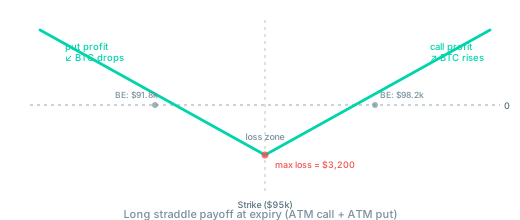
Below $95,000: the put gains value. At $90,000, the put is worth $5,000. If total premium was $3,200, net profit is $1,800.
Above $95,000: the call gains value. At $100,000, the call is worth $5,000. Same arithmetic: net profit $1,800.
At exactly $95,000: both options expire worthless. You lose the entire premium: $3,200. This is the maximum loss and it occurs at the worst possible point — when the market does not move at all.
Breakeven points: $95,000 ± $3,200 = $91,800 and $98,200. BTC must move at least 3.4% in either direction to break even.
Before expiry: the more interesting picture
The V-shaped payoff only applies at the moment of expiry. Before expiry, a long straddle has a curved (U-shaped) payoff because both options still have extrinsic value. The position is approximately delta-neutral near the strike — it does not care about small directional moves. What it cares about is:
- Large price moves (in either direction) — these create intrinsic value in one leg and increase overall position value
- Rising implied volatility — both options gain value from vega exposure
- Time passing — both options lose value from theta decay
This is why a straddle is often described as a bet on realised volatility versus implied volatility. You are paying for a certain level of expected movement (implied vol) and hoping the market actually delivers more movement (realised vol).
The strangle: cheaper entry, wider breakeven
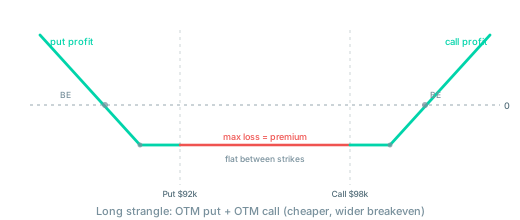
A long strangle uses out-of-the-money options:
- Buy 1 OTM call (e.g. BTC $98,000 call)
- Buy 1 OTM put (e.g. BTC $92,000 put)
- Same expiry for both
Since both options are out of the money, each costs less than the ATM options in a straddle. Total premium is lower — but the breakeven points are wider because the strike gap must be covered first.
Straddle vs strangle: the trade-off
| Long straddle | Long strangle | |
|---|---|---|
| Cost (premium) | Higher | Lower |
| Max loss | Higher (both ATM) | Lower (both OTM) |
| Breakeven distance | Narrower | Wider |
| Gamma | Higher (ATM = max gamma) | Lower |
| Theta decay | Faster | Slower |
| Best for | Expected sharp move soon | Expected large move, timing uncertain |
The straddle is more expensive but starts responding to price movement immediately (high gamma). The strangle is cheaper but needs a bigger move to reach profitability. Both are delta-neutral at inception.
Selling straddles and strangles
The short straddle and short strangle are mirror images — you collect premium upfront and hope the market stays calm:
Short straddle: sell ATM call + sell ATM put. Maximum profit is the total premium received, achieved if BTC expires exactly at the strike. Any significant move creates losses that can be very large.
Short strangle: sell OTM call + sell OTM put. Maximum profit if BTC expires anywhere between the two strikes. The profit zone is wider but the premium collected is smaller.
The risk asymmetry
Selling straddles and strangles has a fundamentally different risk profile from buying them:
- Buying: limited loss (premium paid), unlimited potential gain. You can hold through adverse periods knowing your maximum loss.
- Selling: limited gain (premium received), unlimited potential loss. A single large move — a flash crash, a surprise ETF approval, a liquidation cascade — can exceed months of premium collection in a single session.
This is why professional options sellers continuously delta-hedge their positions and monitor their gamma exposure. Naked short straddles without hedging are among the highest-risk positions in all of finance.
The Greeks of a straddle
Understanding how a straddle behaves requires understanding its Greek exposures:
Delta ≈ 0 at inception. The positive delta of the call roughly cancels the negative delta of the put. As price moves away from the strike, delta shifts — the straddle becomes directional. This is expected and is the mechanism through which it captures profit from movement.
Gamma is at maximum. An ATM straddle has the highest gamma of any simple options structure. This means delta changes rapidly with price — small moves create large delta shifts. For scalpers watching perp markets: high-gamma options positions near expiry create the most aggressive delta-hedging flow from market makers.
Theta is at maximum. High gamma comes with high theta. An ATM straddle decays faster than any other structure. The decay accelerates as expiry approaches — the "theta cliff." This is the cost of the position's responsiveness.
Vega is significant. Both options contribute positive vega (for a long straddle). A 1-point rise in IV increases both the call and put premiums. This is why traders sometimes buy straddles before expected vol events — not to profit from price movement, but from the IV expansion itself.
Practical applications in crypto
Pre-event straddles
Before major events (FOMC, CPI release, Ethereum upgrade, Bitcoin halving), implied volatility typically rises. Traders who expect even higher realised volatility during the event buy straddles. Traders who believe the IV already overprices the event sell straddles.
The critical risk: vol crush. After the event, IV often collapses back to normal levels. If you bought a straddle at inflated IV, the vega loss from IV contraction can exceed any profit from the actual price move — even if the move was significant. This is the most common trap for retail straddle buyers.
Using strangles for longer-dated views
Strangles are often preferred for positions held over days or weeks, because their lower theta decay rate makes them more forgiving of timing errors. If you believe BTC will make a significant move sometime in the next month but are unsure when, a 30-day strangle bleeds less per day than an equivalent straddle.
Reading straddle prices for market sentiment
The price of the ATM straddle is a direct market-implied estimate of the expected move. If a 7-day ATM straddle on BTC costs 4% of the spot price, the market is pricing in approximately a ±4% move over the next week. Comparing this with your own volatility forecast tells you whether options are cheap or expensive.
Synthetic straddles and strangles
In crypto — and increasingly in traditional markets — you do not always need to buy both a call and a put to create a straddle or strangle. You can build synthetic versions using a single option plus the underlying asset. This is cheaper, often more liquid, and achieves the same risk profile.
Synthetic straddle using a call + short underlying
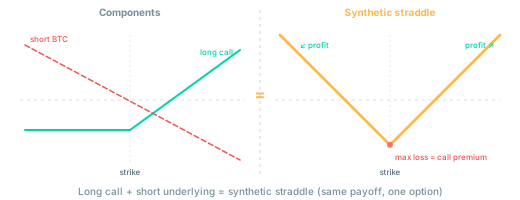
A long call + a short position in the underlying (perp or spot) at the same strike creates a synthetic long put at that strike. Combined with the original call, you effectively have a straddle:
- Buy 1 ATM call ($95,000 strike)
- Short 1 BTC in the perp market at $95,000
This combination behaves identically to a long straddle at the $95,000 strike. Why?
Below $95,000: the short BTC profits, the call expires worthless. Net result: profit from the downside move (just like a put would provide).
Above $95,000: the call profits, the short BTC loses. But the call gains faster due to convexity — the net result is positive for large upward moves.
At $95,000: the call expires worthless, the short BTC breaks even. Net loss = the premium paid for the call — identical to the maximum loss of a straddle.
Synthetic straddle using a put + long underlying
Equally valid — buy a put and go long the underlying:
- Buy 1 ATM put ($95,000 strike)
- Long 1 BTC at $95,000
The long BTC provides the upside exposure; the put provides downside protection plus the ability to profit from a large drop (because the put gains more than the BTC position loses once price moves below the strike minus premium).
Why synthetics are popular in crypto
-
Liquidity. BTC perp markets are far more liquid than options. Building a synthetic straddle using 1 option + perp gives you better execution than buying 2 separate options, especially for larger sizes.
-
Cost. You buy only one option instead of two, paying one spread instead of two. The perp leg has minimal friction.
-
Flexibility. You can dynamically adjust the perp leg (rehedging) without touching the option. This is exactly how professional volatility trading works — the option provides convexity, the perp manages delta.
-
Synthetic strangles. The same principle applies with OTM options: buy 1 OTM call + short enough BTC to delta-hedge = synthetic strangle-like exposure. Or buy 1 OTM put + long enough BTC. The exact payoff depends on the delta at entry, but the principle is identical.
Put-call parity: why synthetics work
The reason synthetics are equivalent to "real" straddles is put-call parity — the fundamental relationship in options:
Call − Put = Underlying − Strike (adjusted for time and rates)
This means: a call at any strike can be transformed into a put at the same strike (and vice versa) by adding or subtracting the underlying. It is not an approximation — it is a mathematical identity. If it ever breaks, arbitrageurs immediately exploit the gap, restoring the equality.
In practice: buying a call and shorting the underlying = buying a put. So a call + short underlying + the original call = two puts... no, simpler: it gives you the same exposure as owning both a call and a put (a straddle), because the short underlying converts half the position's character.
The connection to delta-neutral volatility trading
Straddles and strangles are the most common starting structures for volatility trading. Once you own a straddle, you can:
- Let it ride without hedging (pure bet on expiry payoff)
- Delta-hedge it continuously (pure bet on realised vs implied vol)
Approach 2 is what professional volatility traders do. The straddle provides the convex payoff structure; the delta hedging extracts value from each price fluctuation. The combination transforms a directional instrument into a pure volatility instrument.
Where this track leads
- Volatility trading — how delta-neutral hedging extracts profit from movement, and the full framework for buying and selling volatility.
- Implied volatility and skew — why the price of straddles varies across strikes and expirations, and what the skew tells you.
- The Greeks — the mechanics behind how gamma, theta, and vega interact within straddle and strangle positions.