Options vs Perpetuals: A Different Dimension of Trading
TL;DR. A perpetual future is a precision instrument for directional trading: price goes up, you profit proportionally; price goes down, you lose proportionally. An option introduces a second and third dimension — time and volatility — and with them, a payoff structure that is fundamentally asymmetric: when the market moves in your favour, your gains accelerate; when it moves against you, your losses decelerate. That asymmetry is not a complication. It is the point. Understanding it is the difference between a trader who avoids options and one who uses them deliberately.
Two instruments, two philosophies
Trading a perpetual is like driving a car: every turn of the wheel produces a proportional result. You are in control of direction, and outcomes scale linearly with how right or wrong you are.
Trading options is a different philosophy entirely. You are not steering — you are taking a position on what the market will do. The shape of your profit and loss is not a straight line. It is a curve. And curves behave in ways that straight lines do not.
This is not higher risk in the simple sense. It is different risk, with different tools to manage it. Both instruments belong to a sophisticated trader's toolkit; they answer different questions.
The non-linear payoff — and why it matters
When you buy a call option, your profit-and-loss profile looks like this:
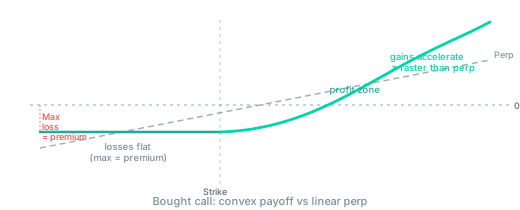
To the left of the strike price: you lose at most the premium you paid. The market can fall 5% or 50% — your loss is capped at the same fixed number. It does not grow.
To the right of the strike price: as price moves in your favour, each additional increment of movement gives you more than the previous one. Your profit curve bends upward — it accelerates. This property is called convexity, and it is unique to bought options.
Compare this to a perpetual: a straight line in both directions. Equal gain per unit of movement in your favour; equal loss per unit against you. Symmetrical and linear.
The option breaks that symmetry deliberately. It replaces unlimited downside with a fixed-cost floor, and replaces proportional upside with an accelerating one. You pay for this — the premium — but what you buy is an asymmetric outcome.
The three edges options give you
Edge 1: Your maximum loss is defined before you enter
When you buy an option, the premium is your worst case. Not "your loss if the stop gets gapped through." Not "your loss if you do not exit fast enough." The exact, mathematical worst case — regardless of how dramatic or fast the adverse move is.
In highly volatile, leveraged markets, this matters. A perpetual with a stop loss provides approximate risk control; in a liquidation cascade or a flash crash, your stop can fill far from where you set it. An option's defined downside holds firm regardless of market conditions.
Edge 2: You can profit from volatility itself, not just direction
A perpetual requires you to pick a direction. An option lets you trade the magnitude of movement — or even the market's expectation of future movement — independently of direction.
Buying volatility directly. Suppose you expect a large move but you are uncertain about direction — a major economic event is approaching, the market has been unusually calm, DVOL is low. You can buy both a call and a put at the current price simultaneously (a straddle). If BTC makes a large move in either direction, at least one of your options becomes highly valuable. If the market stays completely flat, both lose value from time decay. You are not betting on direction; you are betting on movement.
Profiting from vol expansion. When implied volatility is low, options are cheap. If you buy an option on low IV and the market subsequently becomes more uncertain — DVOL rises from 40 to 70 — your option gains value from the vol expansion even if price has not moved yet. You have two potential profit sources running simultaneously: the directional move and the volatility expansion. This is a specific edge that simply does not exist in perpetuals.
Edge 3: The direction-agnostic trade (long gamma)
An advanced but important concept: you can buy an option and simultaneously hedge its directional exposure with a short perpetual position. The result is a trade that profits from movement in either direction — the exact size and speed of the move — while being neutral to the direction itself.
Here is the intuition. You buy a call. Simultaneously, you sell a small amount of the perpetual to offset the call's directional sensitivity (its delta). Now:
- If BTC rallies sharply: the call gains value faster than the perp short loses (because of convexity — the call's delta increases as price rises). Net positive.
- If BTC drops sharply: the perp short gains, and the call loses less than a linear instrument would (convexity again — the call's delta decreases as price falls). Net positive.
- If BTC stays completely flat: you lose — the call's time decay (theta) erodes its value and nothing else compensates.
This structure — a bought option delta-hedged with a futures — is called a long gamma position. You are not betting on direction. You are betting that the market will move — that it will be more volatile than the current premium implies. You profit from being correct about how much the market moves, not which way.
The catch: time is working against you. Every day without meaningful movement, the option's time value erodes. The trade requires movement soon enough to overcome that decay.
The other side: selling volatility
Everything above describes the buyer of options. There is a second valid philosophy: selling options.
The option seller receives the premium upfront. If the option expires worthless (the market did not move enough, or moved the wrong way), the seller keeps the entire premium as profit. The seller profits from time passing and from volatility being lower than implied — the market was calmer than the price of the option predicted.
This is the insurance company's position. Selling options on elevated implied volatility — when premiums are expensive because the market is fearful — and collecting premium as that fear subsides is a coherent strategy with its own risk-reward profile. The risk: a large, fast move against the sold option creates a large, fast loss. The edge: the seller gets to be on the right side of time decay.
Both sides of the options market are legitimate. Buyers want movement and vol expansion. Sellers want calm and vol compression. The market's price — the premium — is the point at which both sides find the trade worthwhile.
The additional dimension you need to master
The genuine challenge of options is not that they are dangerous — it is that they require you to think in more dimensions than directional trading demands.
With a perpetual, the question is: which direction?
With an option, the questions are:
- Which direction, if directional at all?
- Over what time window?
- At what level of volatility — is the current premium cheap or expensive?
- How will time decay affect this trade if the move is slow?
A trader who has developed strong pattern recognition in directional markets and then brings that skill into options — adding the vol and time dimensions rather than replacing what they already know — has access to a set of tools that directional-only trading cannot provide. Defined risk on large speculative positions. Volatility trading independent of direction. Direction-agnostic trades that profit from market activity. And the ability to read the options market itself as a source of information about what sophisticated, well-capitalised participants expect.
That is a different level of trading. It requires more knowledge. It rewards that knowledge proportionally.
Options are not "harder" — they are deeper
It is tempting to think of options as "futures but more complicated" or "futures but riskier." Neither is accurate.
Options are a different category of instrument that answers questions futures cannot. They are more complex in the sense that a surgeon's tools are more complex than a hammer — not because complexity is a problem, but because the job is more precise and the results are more nuanced.
The trader who understands both instruments — who knows when a directional perp trade is the right tool and when a defined-risk options position or a volatility strategy is superior — has a significantly larger toolkit than one who only trades in one dimension.
Further reading
- Options basics — calls, puts, premium, intrinsic and extrinsic value: the foundation.
- The Greeks — delta, gamma, theta, vega: the four forces that shape every options position.
- Implied volatility and skew — how to assess whether an option is cheap or expensive before buying.
- DVOL — the volatility level index that tells you the current price of uncertainty.
- Options for hedging — the most accessible entry point: protecting an existing position.
- Deribit — where crypto options trade, and the source of volatility data the whole market uses.
This article is educational content, not investment advice. Options trading requires a thorough understanding of the mechanics involved. See disclaimer.