Risk of Ruin: Why a Profitable Strategy Can Still Wipe You Out
TL;DR. Positive expectancy tells you that a strategy should make money over a large number of trades. It says nothing about whether your account survives long enough to see that average play out. Risk of ruin is the probability that a losing streak — well within normal variance — destroys your account before your edge has a chance to show up. The single biggest lever controlling this probability is not your edge. It's how much you risk per trade.
The oldest problem in probability
One of the very first problems ever solved using formal probability theory is now known as the gambler's ruin problem: two players, each with a finite pile of chips, play a simple coin-flip game for stakes until one of them runs out of money. Even when the game is fair — a 50/50 coin — the player with the smaller pile is more likely to go broke first, simply because they have less room to absorb a bad run.
Mathematicians in the 17th and 18th centuries were fascinated by this because it revealed something counterintuitive: the outcome of the game depends not just on the odds, but on the size of each player's stake relative to the size of each bet. A player with a tiny edge and a huge bankroll, betting small amounts, is almost guaranteed to win in the end. The same player, betting their entire bankroll on each flip, can lose everything on the first unlucky flip — edge or no edge.
Replace "chips" with your trading account, and "bets" with position sizes, and you have risk of ruin in trading. It is, quite literally, the same 300-year-old math.
Two traders, identical edge, opposite outcomes
Consider two traders running the exact same strategy — same entries, same exits, same +$10 expectancy per trade from the positive expectancy example. The only difference is how much of their account they risk per trade.
Trader A risks 1% of account per trade. Trader B risks 15% per trade. Both strategies have identical, positive expectancy. Both will, on average, make money over a large enough sample.
But "on average, over a large enough sample" is exactly the part that risk of ruin attacks. Before the law of large numbers has time to work in Trader B's favour, a perfectly normal losing streak — say, 6 losses in a row, which happens regularly even at a 45% win rate — wipes out 60–70% of Trader B's account. Trader A, hitting the same losing streak, is down 6%. Trader A is annoyed. Trader B is finished, or close to it — and as the next section shows, "close to it" is far worse than it sounds.
The risk-of-ruin curve
The relationship between risk per trade and probability of ruin is not a straight line — it's a curve that stays flat for a while and then turns sharply upward:
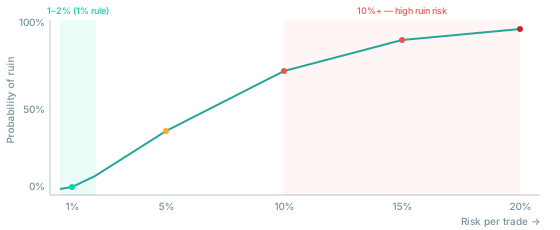
At 1–2% risk per trade — the range covered in risk and sizing — the probability that a normal losing streak destroys the account is close to zero, even for strategies with a fairly modest edge. Past roughly 10%, the curve steepens sharply: the same losing streak that was a minor inconvenience at 1% becomes existential at 10–15%.
This is why the 1% rule isn't a conservative suggestion for the cautious — it's a direct, quantitative control on this curve. Position sizing is risk-of-ruin management. Every time the position sizing formula is applied, what's actually being controlled is where you sit on this curve.
Why drawdowns get worse than they look
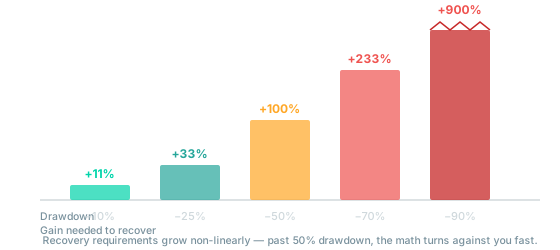
The other half of risk of ruin is recovery math, and it is brutally asymmetric. Losing 10% of an account requires an 11.1% gain to get back to even. That sounds reasonable. But the relationship is not linear:
| Drawdown | Gain needed to recover |
|---|---|
| −10% | +11% |
| −25% | +33% |
| −50% | +100% |
| −70% | +233% |
| −90% | +900% |
A 50% drawdown — losing half the account — requires doubling the remaining capital just to break even. A 90% drawdown requires a 10× return. This is why "I'll just trade smaller and win it back" is mathematically much harder than it sounds once a large drawdown has already happened. The honest takeaway is that the time to control drawdown is before it happens, not after.
Leverage doesn't change your edge — it changes your position on the curve
Leverage is often discussed in terms of liquidation price, and that's correct — but liquidation is just risk of ruin taken to its most literal extreme: a single move large enough to end the account instantly, regardless of how good the underlying strategy is.
Critically, leverage does not change a strategy's expectancy. The entries, exits, and edge are identical whether a position is opened at 2× or 20×. What leverage changes is the size of the bet relative to the bankroll — exactly the variable that the gambler's ruin problem identified 300 years ago as the dominant factor in survival. Two traders with the same edge and different leverage are, mathematically, the two traders from the earlier example: same game, very different odds of finishing it.
Why this matters more in the noisy early phase
Positive expectancy showed that the first 30–50 trades of any strategy are dominated by noise — the rolling average swings wildly before settling near the true expectancy. This is precisely the period where risk of ruin is most dangerous, for two reasons:
- Variance is at its least "averaged out." A losing streak that would be unremarkable across 500 trades can represent a much larger share of your first 50.
- You don't yet have the data to know if the strategy works. A large drawdown in the first 50 trades raises an unanswerable question: is this normal variance, or is the edge simply not there? Oversized risk turns this into a forced decision under pressure, rather than a calm one made with data.
This is part of why testing a strategy properly before risking meaningful capital matters — it lets the noisy early phase happen on capital you can afford to see swing wildly, before sizing decisions have real consequences.
Key takeaways
- Positive expectancy tells you a strategy should work over time. Risk of ruin tells you whether your account survives long enough for "over time" to arrive.
- The dominant variable in risk of ruin is not your edge — it's how much of your account you risk per trade. The 1–2% rule exists specifically to keep you on the flat part of the ruin curve.
- Recovery from drawdown is non-linear: a 50% loss needs a 100% gain to recover, and a 90% loss needs a 900% gain. Controlling drawdown size matters far more than it appears to in the moment.
- Leverage doesn't change your edge. It changes how large your bet is relative to your bankroll — the exact variable that determines survival.
Further reading
- Positive expectancy — why edge is invisible over small samples, and why this is exactly when risk of ruin is most dangerous.
- Risk and sizing — the position-sizing formula and the 1–2% rule in practice.
- Leverage explained — how leverage interacts with liquidation price and account survival.
This article is educational content, not investment advice. Trading derivatives carries substantial risk, including total loss of capital. See disclaimer.