Crypto Support and Resistance: How to Find Key Levels
TL;DR. A support or resistance level is a price where the market has previously made a decision — where buyers stepped in, sellers sold, or a large move began or ended. These decisions leave a memory in the market. That memory drives future behaviour at the same price, until enough new flow overrides it. Understanding levels is less about drawing lines and more about reading where that memory is concentrated — and what the space between levels tells you about how fast price can move.
What a level actually is
Every price level on a chart has a history. At some point, enough buyers or sellers entered the market at that price to cause a visible reaction — a bounce, a reversal, the start of a large move. The traders and algorithms involved remember that interaction, and so does the order book: limit orders tend to cluster at previously significant prices, reinforcing them for future visits.
A support level is a price where buying interest has previously been strong enough to stop or reverse a decline. Price falls to the level, meets demand, and bounces. A resistance level is the mirror: selling interest strong enough to cap an advance.
The mechanism is largely about unfilled orders and positioned traders. When price rallied from $85,000 to $95,000, some traders who missed the move placed buy limit orders back at $85,000 hoping for a second chance. When price returns, those orders are waiting. That cluster of demand — real money, sitting in the book — is what makes the level hold.
Zones, not lines
The first rule of drawing levels: they are zones, not precise lines. The exact price is never as important as the range around it. Price does not have to tick the same number twice to "confirm" a level — it has to get close enough to activate the cluster of resting orders, which spans a range.
In practice, the width of a zone scales with the timeframe and the asset's typical spread and tick size. On a 1-minute BTC chart, a meaningful zone might span $200–$400. On a daily chart, the same idea might span $1,500–$3,000.
Drawing a thin line and expecting price to respect it to the tick is a source of unnecessary losses. Drawing a zone and thinking about whether price has entered it — that is the practical approach.
Three touches that confirm
A level seen once is a hypothesis. Seen twice, a coincidence. A third test at the same zone is a pattern that other participants have also noticed and are likely acting on. This creates a self-reinforcing quality.
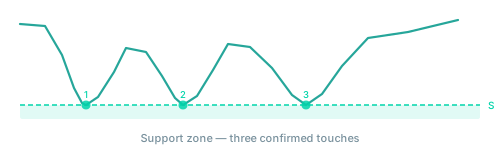
Each time price returns to the zone and holds, more traders are watching and more orders are positioned there. The level becomes something close to common knowledge. That shared attention is part of what makes it work — it is not purely about hidden order flow, but about the collective behaviour of traders watching the same history.
The counterintuitive truth about testing
Here is what most explanations miss: each test of a level also consumes some of the orders waiting there. When price reaches $85,000 and bounces because of resting buy orders, those orders are now filled — they are gone. The next visit to $85,000 has slightly less defensive liquidity to lean on.
A level tested many times without breaking is not necessarily stronger — it may be gradually thinning out. A level that held clean on a single dramatic touch, with strong price rejection (a long lower wick, heavy buying volume), often has more unopened liquidity behind it than a level that has been slowly worn down by five quiet touches.
When assessing a level, ask not just "how many times has this held?" but "how decisively did it hold?" Strong rejection on a single touch can be more meaningful than five gentle bounces.
Role reversal: when a level changes sides
One of the most useful patterns in level trading is what happens after a level breaks decisively. The same price that previously acted as support often becomes resistance — and vice versa. This is called role reversal.
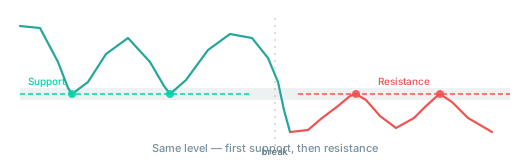
The reason this works is straightforward. Consider buyers who entered at a support level at $85,000. The level holds, price rallies. Then, on a later visit, the level breaks — price drops to $82,000. Those buyers are now holding a loss. Their natural goal becomes to exit flat, selling if price recovers back to $85,000. That concentrated desire to "get out even" creates selling pressure at the old support price — turning it into resistance.
The same logic applies in reverse for resistance-turned-support: traders who sold short at resistance and watched price break higher above them become buyers when price returns, hoping to exit their losing position. Their buying supports the level.
Role reversal is most reliable when the initial break was clean and decisive — not a grind through the level, but a genuine rejection that left trapped participants. The more trapped the losing side, the stronger the role reversal.
Two types of space between levels
The levels themselves are only half the picture. What matters almost as much is the character of the space between two levels.
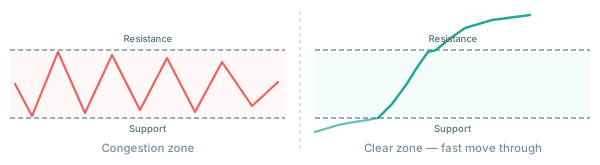
Congestion zones are areas between two levels where price has previously spent a long time grinding back and forth. The chart looks messy — repeated up-and-down movement within a confined range. This tells you that resting orders exist throughout the space, not just at the boundaries. Price has to push through layers of opposing orders to make progress. Movement inside a congestion zone is slow, choppy and prone to reversals. Scalping through the middle of a congestion zone is expensive: you pay spread and fees fighting against resistance that has no clear origin point.
Clear zones (or free zones) are the opposite: areas between two levels where price has previously moved in a clean, fast, largely uninterrupted line. The chart shows a single strong candle or a short series of momentum candles with no pullbacks. That history tells you there is little historical order density in that space. If price enters this zone again, it tends to move through it quickly — the same thin order book that allowed fast movement before usually allows it again.
The practical consequence: when a level breaks and price enters a clear zone, the next level up (or down) is often reached much faster than the chart spacing might suggest. When price is grinding through a congestion zone, patience matters — the move will come, but slowly.
What adds weight to a level in crypto
Not all levels are equal. Several factors reinforce a level beyond its simple price-chart history:
Round numbers work because they are psychologically salient to every participant. $90,000, $95,000, $100,000 attract large clusters of limit orders purely because traders use round numbers as reference points. When a round number also coincides with a prior swing high or low, it carries double weight — chart significance plus psychological anchor.
Options strikes add a layer unique to crypto markets. Large open interest at a specific strike on the Deribit options chain (particularly near weekly expiry) creates a gravitational effect through market maker hedging. A strike with significant open interest — especially one that coincides with a chart level — has structural support in a way that a purely chart-derived level does not. This is a genuine advantage of reading the options market alongside the price chart.
Multiple timeframe confluence is the simple version of the above principle: a level that appears significant on the 1-hour chart and the 4-hour chart and the daily chart carries more weight than one visible only on the shorter timeframe. When multiple timeframes agree that a price zone is important, more participants are acting on it.
High-volume nodes from historical trading activity — prices where a disproportionate amount of volume changed hands — create zones where both buyers and sellers have established positions at cost, making them sensitive territory.
Reading levels across timeframes
The practical approach for scalpers is to build a map top-down:
- Daily chart — mark major swing highs, swing lows and prominent consolidation ranges. These are the heavy structural levels that require significant effort to overcome. They are not for entry timing; they set the backdrop.
- 1-hour chart — mark the levels relevant to the current session: yesterday's high and low, overnight consolidation boundaries, the levels where the current day's price action has already reacted.
- 5-minute chart — the immediate tactical grid: recent local highs and lows from the last few hours.
The hierarchy matters: if price is approaching a daily resistance level, the 5-minute chart might show a long setup — but the daily level will provide a natural ceiling. Knowing it is there prevents you from holding through a reversal that the higher-timeframe map already told you was coming.
What levels cannot do
Levels are one of the most useful tools in a scalper's toolkit and also one of the most abused. Some honest limits:
They get broken. Any level will eventually be overcome if enough directional pressure builds. No level is permanent. The useful question is not "will this hold?" but "what happens to my trade if it does not?"
Fake breaks trap traders. Price deliberately piercing a well-known level — only to reverse sharply — is among the most common patterns in liquid crypto markets. The mechanism is the same as stop-hunt: concentrated stop orders and limit entries at obvious levels attract price. A single candle breaking through and then closing back inside the zone is not a confirmed break. Confirmation requires a sustained move and, ideally, a failed retest from the other side.
High-impact events invalidate levels temporarily. A macro shock, a sudden regulatory announcement, a large exchange failure — any of these can create a gap or an avalanche that ignores every level on every timeframe. In those moments, the order book empties, liquidation cascades override structure, and the levels you drew are irrelevant until the dust settles.
Further reading
- How price moves — the underlying mechanics of why levels attract price.
- Order book and DOM — real-time view of the order density that makes levels visible as they are forming.
- Max pain and options strikes — the options-derived layer of level strength specific to crypto.
- Range trading and breakouts — how to trade the zones between levels.
- Common mistakes — over-drawing levels is one of them.
This article is educational content, not investment advice. Trading derivatives carries substantial risk, including total loss of capital. See disclaimer.