Crypto Trade Execution: Fees, Slippage & Order Quality
TL;DR. A technically perfect setup with poor execution is a losing trade. In scalping, where margins per trade are small and trade frequency is high, execution quality compounds — for better or worse — faster than almost anything else. The difference between a disciplined limit-order approach and a careless market-order habit is not philosophical; it is measurable in dollars per session.
The true cost of a round trip
Most traders think about trading costs as the fee shown on the exchange. That number is real, but it is not the full picture. A round trip — entering and then exiting a position — has three distinct cost components:
1. Trading fees: The exchange's maker or taker fee on each leg. Two legs means two fees.
2. Spread: The gap between the best bid and best ask at the moment you trade. If you enter with a market order, you cross the spread — you buy at the ask (slightly above fair value) and later sell at the bid (slightly below). You pay this gap twice per round trip.
3. Slippage: The difference between the price you expected and the price you actually received, caused by your order moving the book or by the market moving between your decision and your fill.
On a major BTC/ETH pair during active hours, the spread is typically one or two ticks — small, but not zero. The combined cost of spread and fee on a round trip matters far more to a scalper than to a position trader, because scalpers repeat the cycle many times per session.
The order type decision: numbers, not opinion
The advice "use limit orders, not market orders" is common but rarely explained in terms that make the stakes clear. Here is what the difference looks like in practice.
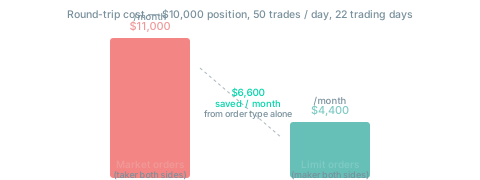
Assumptions: $10,000 notional per trade, Binance USDT-M, 50 round trips per day.
| Approach | Maker/taker fees | Round-trip fee cost | 50 round trips / day | Monthly (22 days) |
|---|---|---|---|---|
| Both legs market order | 0.05% × 2 | 0.10% = $10 | $500/day | $11,000 |
| Both legs limit order | 0.02% × 2 | 0.04% = $4 | $200/day | $4,400 |
| Difference | $6/trade | $300/day | $6,600 |
That $6,600 monthly gap is purely from order type choice — before accounting for any spread or slippage difference. No edge, no strategy, no read of the market changes this. It is mechanical and constant.
At 100 round trips per day, the gap doubles. At $50,000 notional, it multiplies by five.
This is why professional and semi-professional scalpers are almost obsessive about limit order discipline. Every unnecessary market order is a transfer from your account to the exchange.
When market orders are necessary
Limit orders are not always appropriate. There are genuine situations where accepting taker fees is the correct choice:
Getting out of a losing trade quickly. When you need to exit because your read was wrong and price is moving against you, speed beats cost. A market order exits immediately; a limit order may sit unfilled while the loss deepens. The extra taker fee on an exit is trivially small compared to holding through a deteriorating position.
Entering a genuine momentum break. Some setups require being in the trade now — a breakout on heavy volume, a liquidation cascade moving fast. Posting a limit order and waiting for it to fill means the entry price may be significantly different from where you posted it by the time it fills, negating the benefit of the limit. In fast-moving conditions, the taker fee is the cost of participating.
The rule: use limit orders as the default for all planned entries. Use market orders when speed is genuinely the priority — exits under pressure, and momentum entries where every tick of delay changes the trade.
Slippage: what it is and how to control it
Slippage is the gap between your expected fill price and your actual fill price. It comes from two sources:
Market impact slippage: Your order is large enough relative to the available liquidity that it consumes multiple price levels to fill. Relevant for large orders on thinner instruments.
Latency slippage: Price moves between when you decide to trade and when your order reaches the exchange and executes. In a fast-moving market, a web UI adds a few hundred milliseconds. At $50,000 BTC, that can mean $5–25 of slippage on a market entry during a sharp move.
For retail-size scalping (positions up to a few BTC equivalent) on the liquid major pairs, market impact slippage is usually negligible. Latency slippage during calm conditions is also small. The moment that matters is a fast spike or cascade — in those conditions, market orders can fill multiple ticks away from where you see the price on screen.
How to limit it:
- Size within the visible liquidity at your price level. The order book shows you the depth. If you can see 10 BTC resting at the ask and your order is 0.2 BTC, you will fill cleanly.
- Prefer limit orders with post-only mode for entries. You cannot have latency slippage on a limit order — it fills at your price or not at all.
- Accept that slippage is the cost of speed. If you need the speed, pay the cost consciously, not accidentally.
Post-Only mode: the maker guarantee
Most major exchanges offer a Post-Only flag on limit orders. When enabled, the exchange checks before placing your order whether it would immediately cross the spread and fill as a taker. If it would — because the market moved into your limit price — the exchange either cancels the order or rejects it, rather than executing it at taker cost.
This is a clean way to ensure your limit orders always execute at maker rates. The trade-off: in a fast-moving market, a post-only order may be cancelled the moment you place it, requiring you to re-enter. For calm entries at defined levels, it is a simple way to guarantee maker execution.
Partial fills and what to do about them
A limit order sitting in the book may not fill completely in a single moment. Large resting orders at a price level fill against multiple smaller aggressive orders over time. If your limit order partially fills, you hold a position smaller than intended.
The decision: wait for the remainder to fill, move the remaining order, or accept the partial. There is no universal answer — it depends on whether the setup is still valid and whether the missed size materially changes the risk parameters. The habit to avoid: chasing the fill by immediately converting the remainder to a market order, which turns a disciplined limit entry into a taker fee on the most important part.
The psychological execution trap
The most expensive execution mistake is not a technical one. It is behavioural.
A setup forms. You have a plan: enter at a specific price with a limit order. Price reaches the level — but slightly past it, before you click. You experience a familiar sensation: the move is happening without you. You click market buy.
You have now entered a trade at a materially different price than your plan specified, paid taker fees, and — most importantly — you no longer know whether the risk/reward is valid, because your entry and therefore your stop and target relative to entry have all shifted.
This impulse — entering a market order because the price moved beyond your planned limit — is one of the most consistent ways to accumulate small losses that have nothing to do with your market read. The setup was right. The execution made the trade unprofitable.
The discipline: if the limit order did not fill, the trade did not trigger. Let it go. A good setup missed is less costly than a bad execution repeated 50 times.
A simple execution checklist
Before placing any entry order:
- What type? Limit (default) unless the situation genuinely requires speed.
- Post-Only? For planned levels in calm conditions, yes.
- Size vs visible book depth? Can the book absorb my order at this level without moving the price?
- Where is my stop? Placed immediately after fill, not "in a moment."
- Is the move already past my level? If yes — let it go, wait for the next setup.
That last point is the hardest. It is also the one that, once consistent, improves results the most.
Further reading
- Order types explained — limit, market, stop, stop-limit: the mechanics of each.
- Order book and DOM — reading available depth before sizing your order.
- Risk and position sizing — execution is the final step; sizing comes before it.
- TradingView setup — the practical interface layer where execution decisions happen.
This article is educational content, not investment advice. Trading derivatives carries substantial risk, including total loss of capital. See disclaimer.