Positive Expectancy: The Only Number That Decides If a Strategy Works
TL;DR. Expectancy is the average result you can expect per trade, averaged over a large number of trades. A strategy with positive expectancy makes money over time even though most individual trades are essentially random. A strategy with negative expectancy loses money over time even if it produces winning streaks along the way. Everything else — entries, indicators, chart patterns — only matters insofar as it shifts this one number above zero.
A 400-year-old gambling dispute
In the 1650s, a French nobleman with a taste for dice games asked a mathematician friend a practical question: if a game is interrupted partway through, how should the stakes be divided fairly between the players, based on each player's chances of winning if play had continued?
The mathematician — Pascal — and his correspondent Fermat worked through the problem in a series of letters. Their answer didn't just settle a dice dispute. It introduced a new way of thinking: instead of asking "what will happen on the next roll," they asked "what is each outcome worth, multiplied by how often it happens, summed up?" That sum is what we now call expected value.
It took another half-century for Jacob Bernoulli to prove the second half of the idea: that as you repeat a random process more and more times, the average outcome converges on that expected value — even though no individual repetition is predictable. Together, these two ideas are the entire mathematical foundation of every casino, every insurance company, and every trading strategy that has ever made money consistently.
A casino doesn't know whether the next roulette spin will be red or black. It doesn't need to. It knows that over millions of spins, its tiny built-in edge (roughly 2.7% on European roulette) will show up as profit, almost exactly. Scalping works on the same principle — just with a smaller, harder-to-find edge, and a much noisier environment.
What expectancy actually means
Expectancy is the average profit or loss you should expect per trade, calculated as:
Expectancy = (Win Rate × Average Win) − (Loss Rate × Average Loss)
If this number is positive, the strategy makes money over a large enough sample. If it's negative, it loses money over a large enough sample — no matter how it feels in the short run.
The diagram below shows the anatomy of a single trade's expectancy. Each trade is really two possible branches — a win branch and a loss branch — each weighted by how often it happens:
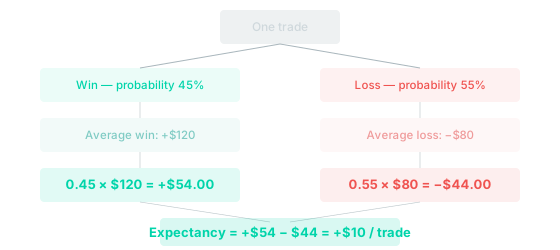
Notice what this example shows: the strategy loses more often than it wins (55% vs 45%), and yet it has positive expectancy, because the average win is large enough relative to the average loss. This is the core insight that separates expectancy from win rate — a topic covered in full detail in win rate vs risk/reward.
Why a positive-expectancy trade can still lose
This is the part that trips people up: expectancy describes the average, not any single outcome.
A strategy with +$10 expectancy per trade does not produce +$10 on the next trade. It produces either +$120 or −$80 (in the example above) — never +$10. The +$10 is what you get when you average across many, many trades. Any individual trade — or string of ten trades — can land far from that average purely due to randomness.
This means:
- A genuinely good (positive-expectancy) strategy can lose 5, 8, even 12 trades in a row. This is statistically normal, not a sign the edge has disappeared.
- A genuinely bad (negative-expectancy) strategy can win 5, 8, even 12 trades in a row. This is statistically normal too — and it's how negative-expectancy systems convince people they work, right before they don't.
If you cannot distinguish between "a string of losses because variance is variance" and "a string of losses because the edge is gone," you will do exactly the wrong thing at exactly the wrong time: abandon a working strategy after a normal losing streak, or keep trading a broken one because it "was working last week."
The law of large numbers, visualised
Bernoulli's insight — that the average converges to the expectation as the sample grows — is the reason edge is invisible at small sample sizes and visible at large ones.
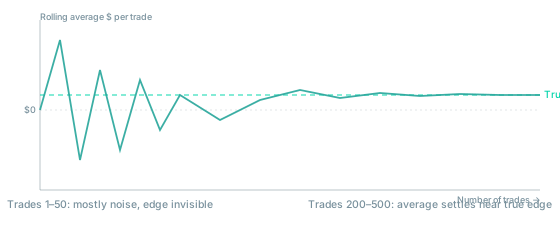
Over the first 30–50 trades, the rolling average bounces around wildly — it might show the strategy losing money, then winning heavily, then losing again. None of this tells you much about the underlying edge. By 200–500 trades, the noise has mostly cancelled out and the average settles close to the true expectancy.
This is why paper trading for a weekend tells you almost nothing, and why a single bad week says nothing about whether your strategy is broken. The sample is too small for the law of large numbers to have done its work yet.
The psychological trap: judging edge by how it feels
Humans are pattern-matching machines, and pattern-matching is exactly the wrong tool for evaluating expectancy.
Recency bias makes your last few trades feel disproportionately important. Three losses in a row feels like proof something is wrong — even when three losses in a row is the expected behaviour of a strategy that wins 45% of the time (it happens roughly once every 6 sequences of three trades).
The hot-hand illusion works in the other direction. A short winning streak on a mediocre or negative-expectancy setup feels like validation — "I've figured something out" — when it's statistically indistinguishable from a lucky run at a roulette table.
The gambler's fallacy is the reverse error: believing that after several losses, a win is "due." It isn't. Each trade's outcome (assuming independent setups) doesn't know or care what happened on the previous ones.
The only reliable defence against all three is the same: track results over a large sample, calculate expectancy from the data, and trust the number over the feeling. How to start scalping and win rate vs risk/reward cover the practical mechanics of building that track record.
Where positive expectancy comes from in scalping
Expectancy doesn't appear from nowhere — it comes from a real, recurring market behaviour that puts the odds slightly in your favour. In crypto scalping, common sources of edge include:
- Liquidity-driven moves — price tends to gravitate toward areas where resting orders cluster, making certain levels more predictable than random (how price moves).
- Range behaviour — markets spend most of their time oscillating between support and resistance, which range-fade approaches exploit (range fade).
- Breakout follow-through — when a range finally breaks with conviction, the move often continues further than a reversal trader expects (range breakouts).
- Stop-hunt reversals — price sweeping through an obvious level to trigger stops, then reversing, because the sweep itself was the objective (stop-hunt reversal).
None of these patterns work every time. None of them need to. They each need to work often enough, by enough margin, that the resulting expectancy is positive after fees. That's the entire game.
Key takeaways
- Expectancy = (Win Rate × Average Win) − (Loss Rate × Average Loss). This single number determines whether a strategy is worth trading.
- A positive-expectancy strategy can still produce long losing streaks. A negative-expectancy strategy can still produce long winning streaks. Neither is meaningful evidence on its own.
- Edge only becomes statistically visible over roughly 100–200+ trades — not a session, not a week.
- Your job as a trader is not to be right on each trade. It is to repeatedly take trades where the math is in your favour, and let the law of large numbers do the rest.
Further reading
- Win rate vs risk/reward — the full formula breakdown, break-even tables, and how to measure your own expectancy.
- Risk and sizing — why position sizing determines whether you survive long enough for positive expectancy to pay off.
- How to start scalping — building a track record large enough to mean something.
This article is educational content, not investment advice. Trading derivatives carries substantial risk, including total loss of capital. See disclaimer.